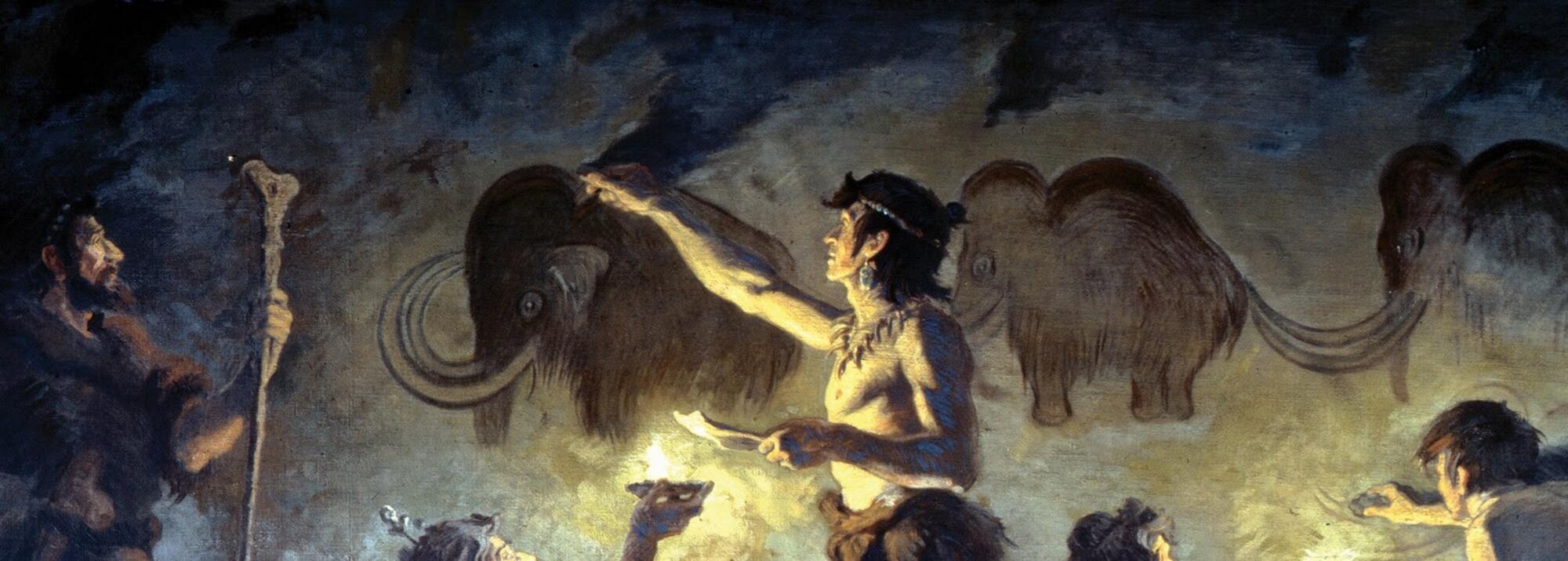

The discovery of Font-de-Gaume rekindled the debate about cave art, which at the time was not given great consideration. At the time, its authenticity was called into question, in particular because of questions relating to the lighting of the caves.
Recognition of the art
The debate on the recognition of cave art was launched in 1879 with the discovery of the paintings on the large ceiling of the Altamira cave (Spain) by Don Marcellino de Sautuola. This find remained the only one of its kind for more than 15 years, but in the mid-1890s, discoveries at La Mouthe (Dordogne), Pair-Non-Pair (Gironde) and Marsoulas (Haute-Garonne) provided new evidence. A body of work began to emerge that opened the eyes and minds of researchers, prompting them to rethink certain finds, such as the Chabot cave (Gard), where engravings were reported in 1878. The discoveries of Combarelles and Font-de-Gaume (Dordogne) in 1901 brought the debate to a favourable conclusion, and led to further discoveries.
| Year | Site | Discoverer |
|---|---|---|
| 1878 | Grotte Chabot (Aiguèze, Gard) | Léopold Chiron |
| 1879 | Altamira cave (Santillana del Mar, Cantabria, Spain) | Marcelino de Sautuola |
| 1895 | La Mouthe cave (Les Eyzies-de-Tayac, Sireuil, Dordogne) | Emile Rivière |
| 1896 | Pair-Non-Pair cave (Marcamps, Gironde) | François Daleau |
| 1897 | Marsoulas cave (Haute-Garonne) | Félix Régnault |
| 1901 | Combarelles cave (Les Eyzies-de-Tayac, Sireuil, Dordogne) | Denis Peyrony, Father Breuil, Louis Capitan |
| 1901 | Font-de-Gaume cave (Les Eyzies-de-Tayac, Sireuil, Dordogne) | Denis Peyrony |
| 1902 | Bernifal cave (Meyrals, Dordogne) | Denis Peyrony |
| 1903 | La Mairie cave (Teyjat, Dordogne) | Denis Peyrony, Pierre Bourrinet |
| 1903 | La Calévie cave (Les Eyzies-de-Tayac, Sireuil, Dordogne) | Denis Peyrony |
| 1904 | La Grèze cave (Marquay, Dordogne) | Dr Ampoulange |
The terms of a debate
In the debate over the authenticity of Palaeolithic cave art, each discovery provides new evidence to counter the arguments of those who doubt its authenticity. The La Mouthe lamp solved the question of lighting, and the discovery of engravings masked by stratified deposits provided evidence of their age…
However, it was the profound change in ideas about prehistoric man that occurred at the very end of the 19th century that helped to move the debate forward. Prehistorians now recognise the complexity of these humans' technical, cultural and symbolic thinking, and claim that they were also artists.

Sandstone lamp engraved with an ibex, discovered in the decorate cave of La Mouthe (Les-Eyzies-de-Tayac). Saint-Germain-en-Laye, National Archaeology Museum, Rivière collection, inv. 50 295 (© RMN – Grand Palais / Ch.Jean and J. Schormans.)
This shaped object was an important argument in the debate on cave art, settling the question of lighting.

