
When the cave became state property in 1902, the development of tourism triggered the need to consider how the paintings were to be preserved. The first policies were essentially interventionist and curative, then increasingly preventive, while the cave was under the oversight of the Centre des monuments nationaux (National Monuments Centre).
Very soon state property
Thanks to the generosity of Léon Delmares, the Font-de-Gaume cave became state property (Beaux-Arts administration) shortly after its discovery. It was granted protection as a Historic Monument on 3 July 1902. However, it took a few more years to put an end to the vandalism it had suffered for decades (see graffiti). It was opened to the public in 1910. When it was electrified in 1920, it became the first cave in France to be equipped for visits by the public. A century later, its success remains undiminished. In the 1990s, the State was finally able to buy back the land surrounding the entire network, thereby taking control of this sensitive area. Today, Font-de-Gaume is under the responsibility of the Centre des monuments nationaux, which, on behalf of the state, ensures that it is accessible to the public, preserves it and manages all its maintenance work.
From the outset, the authors of the famous 1910 monograph were concerned with the problems of preserving this extremely fragile historical site. In particular, they astutely attributed the almost complete erosion of the decoration found along the first few metres of the network to the medieval development of its entrance and of the network before the Rubicon (lowering of the ground), which resulted in increased air circulation. It is in a stable, confined area that the decoration is best preserved.

Entrance to the cave; on the right, a plaque commemorating the centenary of the discovery of the Font-de-Gaume cave (1901–2001). (© Ph. Jugie – CMN/CNP.)
Initial conservation measures
Following the Second World War, and the discovery of the Lascaux cave (Dordogne), the development of tourism led the central government to take measures to prevent or limit damage to the paintings caused by rubbing or contact. In narrow areas, the ground was excavated and archaeologically inspected. In more spacious areas, physical protection was provided (railings, glazing). Overall, the public walkway has been lowered by 60 to 70 centimetres, in fact by between 0.10 and 1.25 metres depending on the sector, but there are still a few areas reserved for potential excavation.
Archaeological work in the main gallery was supervised by Séverin Blanc in 1951, for the first section between the Rubicon and the Crossroads, and then by François Prat, in 1967 and 1968, for the section between the Crossroads and the Chamber of the Bison. The electrical installations were also renovated in 1973. At the same time, various attempts have been made to improve the legibility of the paintings naturally covered by calcite: the thinning of the concretion by brushing, abrasion or gentle impact has produced spectacular results, particularly on the last frieze of the bison.
The utmost caution is needed to avoid the serious conservation problems that led to the closure of Lascaux in 1963. Under the leadership of Laboratoire de recherche des Monuments historiques (Historical Monument Research Laboratory), thermal studies are being carried out (human presence in the cave significantly increases its internal temperature), measuring variations in temperature, air circulation, humidity, CO2 content (which, in the presence of condensation water, can cause the dissolution of limestone), etc. All these parameters, which are interactive, cannot be equally controlled. An attempt is therefore being made to limit one of these factors, the presence of CO2, by using an electric pumping system to supplement the natural depressurisation of the cave.
Use of the cave by the public also causes other issues: the introduction of organic matter and various debris deposited on the walls, and their general soiling, create the conditions needed for the development of many potentially dangerous micro-organisms (fungi, mould, etc.), aggravated by the presence of lights. It therefore seems essential to neutralise these phenomena by regularly applying biocidal treatments using sprays, followed by thermal fogging with a variety of chemical products. As is easy to see, the conservation policy implemented was essentially interventionist and curative until 1990, even though the medium-term and long-term effects were not necessarily under control (see Lascaux).
Next slide
Previous slide
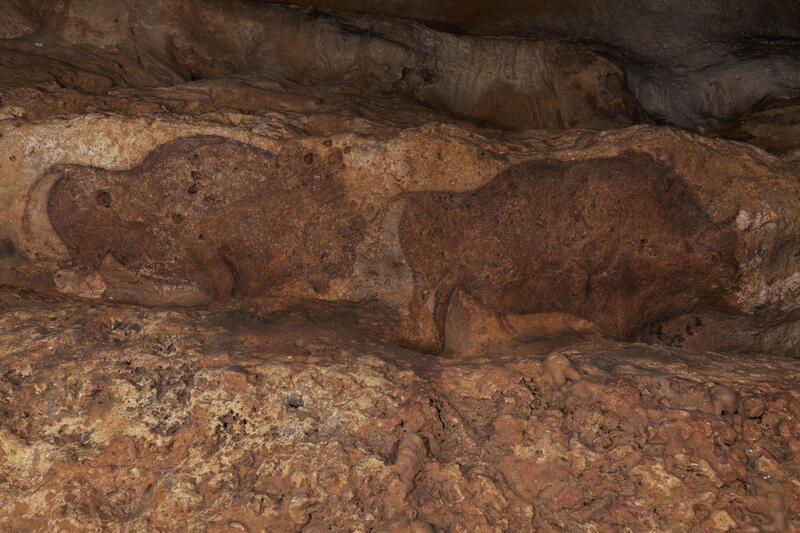

Detail of the Bison frieze, decorated area, main gallery, second section. (© Olivier Huard / Centre des monuments nationaux)
Water collector and drainage pump, decorated sector, Chamber of the Bison (© Ph. Jugie – CMN/CNP.)
Promoting risk prevention
Since the 1990s, following the proposals of Norbert Aujoulat, a leading specialist in the underground environment and curator at the Centre national de Préhistoire and head of the cave art department, the cave's new administration (part of the Centre des monuments nationaux) has introduced a radically different conservation policy. It promotes risk prevention and seeks to keep technical intervention to a minimum. Permanent climatic monitoring, regular biological monitoring, etc., have enabled the Bordeaux hydrogeology laboratory to define an equilibrium threshold based on the principle of the cave's stability and its capacity to restore equilibrium: any cave can withstand a slight change in its environment without damage, provided that it is only temporary. The rise in temperature, for example — each visitor essentially functions as a 50–100 watt micro-radiator! — must be low enough, even in summer, for the cavity to return to its natural temperature on a daily basis. The threshold was recently set at 80 people per day (for a 30-minute visit). The benefits are obvious: for several years now, Font-de-Gaume has been perfectly stable and no longer requires any treatment. Subject to changes in the current climatic regime, the public should be able to visit this cave without posing any major risks that could lead to the disappearance of its works.
Next slide
Previous slide


Climatological station, end of the side gallery. (© Ph. Jugie – CMN/CNP.)
Climatological station sensor, main gallery. (© Ph. Jugie – CMN/CNP.)