
The year 1901 marked the beginning of Font-de-Gaume's contemporary history. As soon as it was discovered, the cave took on considerable importance in scientific debates on prehistory, becoming proof of the authenticity of Palaeolithic cave art.
Story of the discovery
On 12 September 1901, a few days after identifying the engravings in the Combarelles cave together with Father Breuil and Louis Capitan, Denis Peyrony explored the cave at Font-de-Gaume. He recognised a number of engravings and paintings and immediately sent letters and telegrams to his two colleagues who had left the Dordogne.
They returned to Les Eyzies and on Saturday 21 September the trio explored the cave and its works in depth. The researchers drew up a map of the cave, identified 77 engraved and painted figures, and traced several of them using tracing and watercolours. Capitan wrote a note, in the cave itself, that was to be presented to the Académie des Sciences as soon as possible.
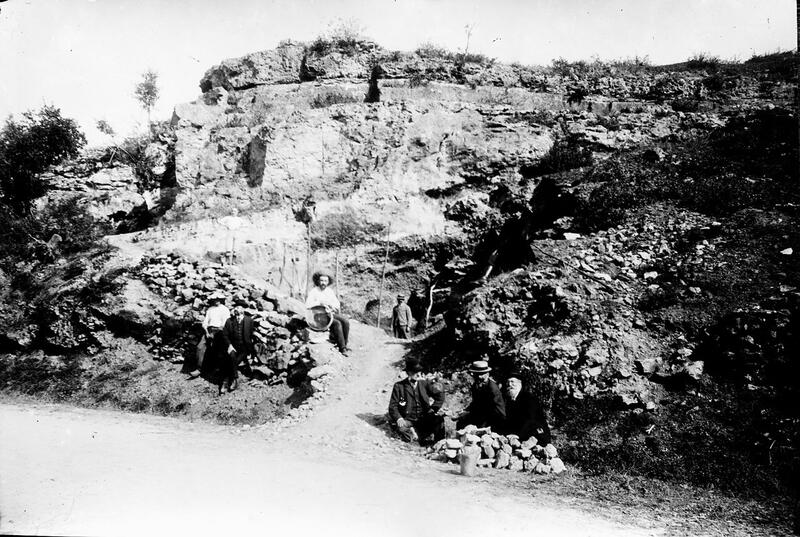
Father Breuil, Louis Capitan, Denis Peyrony and Émile Cartailhac at the discovery of the La Ferrassie burial site 1, 27–29 September 1909. Les Eyzies-de-Tayac, National Prehistory Museum, library, Peyrony collection, Ferrassie B2. (© MCC/MNP.)
First papers and publications
At the beginning of the 20th century, the authenticity of cave art was the subject of debate, and a discovery such as that at Font-de-Gaume or Les Combarelles was, in the words of Breuil "a great big firecracker in the prehistoric world" (letter sent by Breuil to Jean Bouyssonie, 10 September 1901, Paris, main library of the museum). It was therefore important to ensure scientific ownership. The swift presentation of a memorandum to the Académie des Sciences on 23 September 1901 was an excellent way of achieving this. The situation was urgent: Émile Rivière, who discovered the engravings in the La Mouthe cave in 1895, was prospecting in the region at the time, and could well have overtaken his three colleagues.
Font-de-Gaume and the debate on cave art
The discovery of Combarelles and Font-de-Gaume was the final addition to a demonstration based on a body of work that was still limited, but extensive enough to be convincing. It came at just the right time, at a time when ideas surrounding prehistory were changing radically, under the influence of a new generation of prehistorians, of whom Father Breuil was a particularly active representative.
With the support of Émile Cartailhac, he brought the debate to the congress of the French Association for the Advancement of Science (Association française pour l’avancement des Sciences), held in Montauban in 1902. The congress discussed and visited the caves at Les Eyzies and confirmed the authenticity of the Palaeolithic cave art.
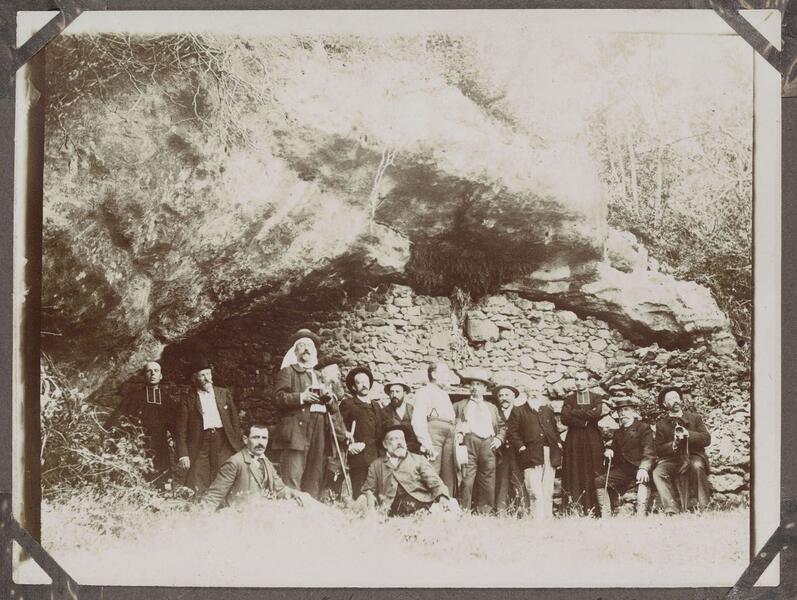
Congress of the French Association for the Advancement of Science on an excursion to Les Eyzies-de-Tayac in 1902. Saint-Germain-en-Laye, National Archaeology Museum, library, Breuil collection, album no. 1, folio 8 (© RMN – Grand Palais / Th. Le Mage.)