

The modern and contemporary graffiti at Font-de-Gaume testifies to its recent use. Quotas were introduced in the 1970s, definitively establishing the framework for visitor numbers.
Recent use of the cave
In addition to various fragments of pottery from medieval times and even later, evidence of recent use of the Font-de-Gaume gallery can be found primarily in the graffiti dating from the modern or contemporary period: over 70 of these are clearly legible, featuring names or initials and a few geographical origins. Often on the walls, more rarely on the ceiling, they affect all areas of the cave, including beyond the Rubicon and at the bottom of the side gallery. The earliest date from 1874, with the majority dating from between 1880 and 1900, and some even date from after the cave’s discovery, 1908–1909, leaving us perplexed as to the initial measures taken to protect it.
Following the initial exploratory work of Louis Capitan,Father Breuil and Denis Peyrony published in 1910, which consisted more of collecting objects on the surface than actually excavating the cave, electrification made the cave accessible to the general public from 1910 onwards, and even more so from 1920 onwards, the year in which a tourist office was also established in Les Eyzies. Curiously, this opening up was the first step towards protecting the cave, as no subsequent graffiti would damage the wall. Unregulated, the number of visitors could reach 1,500 to 2,000 people daily. In order to better protect the cave paintings, the original ground level was lowered (between 0.10 and 1.25 m, on average 0.70 m) and several excavation campaigns were carried out (Séverin Blanc, François Prat, etc.), mainly between 1951 and 1968.
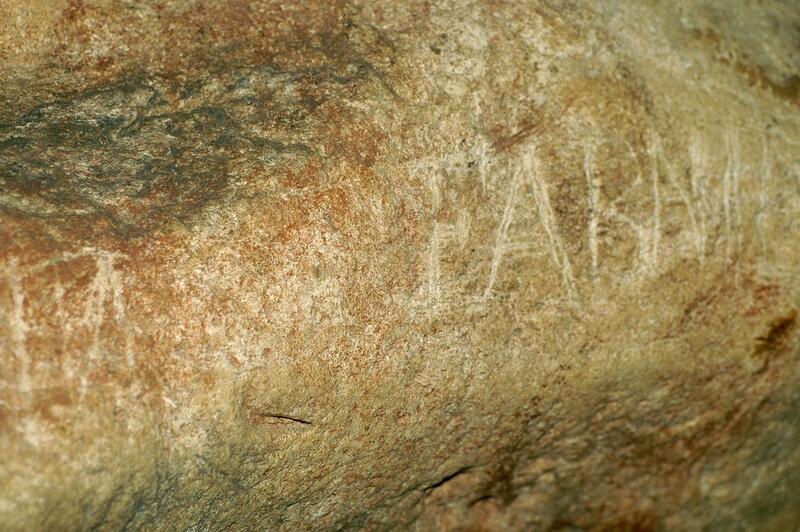
Graffiti from the mid-19th century, decorated area, main gallery, first section. (© Ph. Jugie – CMN/CNP.)
The first quotas
From the 1970s onwards, as climatic and biological disturbances took hold, it became necessary to establish visitor quotas. These were initially set to improve the comfort of the public, negatively impacted, for example, by the concentration of carbon dioxide above the Rubicon. From 650 people a day in 1970, the figure fell to 340 in 1979 and 200 in the early 1990s. Today, the maximum number of visitors allowed is 80 per day for a visit lasting around 30 minutes: while the comfort of the public remains fundamental, the main requirement remains the climatic and biological stability of Font-de-Gaume's underground environment, which becomes threatened when this threshold is exceeded. The current general change in the climate means that there is good reason to believe that these figures could be further reduced, particularly during the summer period.
Associated media
Open Media Library