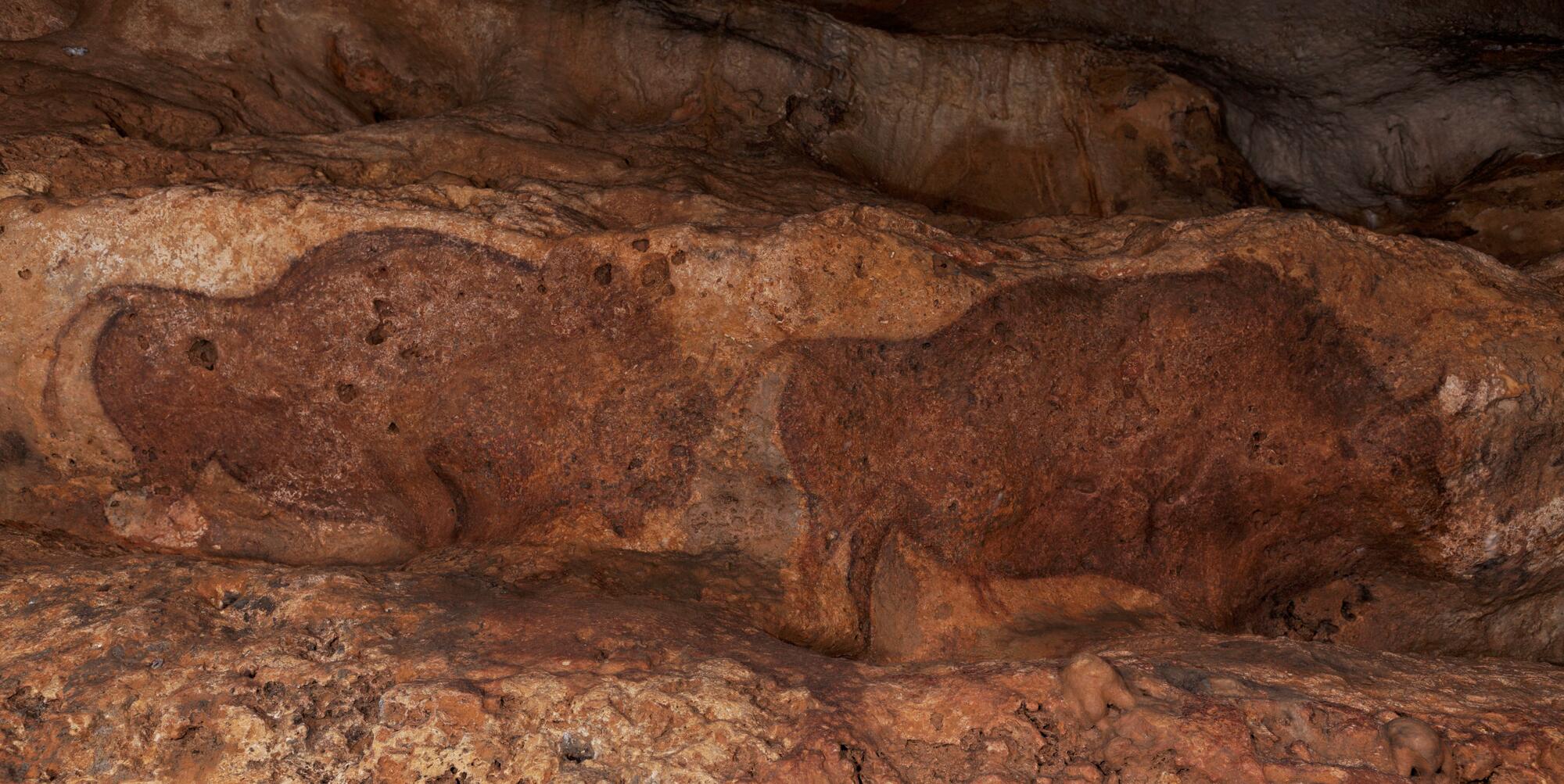

The steppe bison (Bison priscus), the emblematic animal of the Font-de-Gaume cave, greatly inspired the depictions of prehistoric artists. Superimposed, exaggerated and painted in polychrome, the bison occupy an important place in the iconography of the cave, which is named after them.
A prehistoric animal
The bison depicted on more than fifty occasions in the Font-de-Gaume cave is the steppe bison, Bison priscus. It is a close relative of today’s European bison (Bison bonasus), which still lives in semi-freedom in some of the forests of Central and Eastern Europe. It should not be confused with its cousin the American bison (Bison bison), which can be distinguished by the general shape of its body and primarily by the extremely low carriage of its head.
The steppe bison became extinct just over 10,000 years ago. It was gradually replaced by the forest-dwelling animal, which spread over a large part of Eurasia. The European bison is a powerful animal, but more slender than its American cousin. It has a robust, broad head topped by two short, curved horns. The eyes are set in characteristic protruding orbits and the ears, which end in a tuft of hair, are generally clearly visible. The fleece that covers its entire body is dense and its spring moult is spectacular. The woolly coat falls off in patches, revealing the short summer hair. This change of "livery" was often noticed by prehistoric artists, as in Lascaux.
Bison and Palaeolithic art
While Font-de-Gaume can rightly be considered the "cave of the bison", it should not be forgotten that this animal is one of the most common in Palaeolithic art, along with horses, mammoths and, to a lesser extent, aurochs. In the Dordogne, during the Magdalenian period, the animal was depicted on all kinds of substrate. In the caves near Combarelles or Bernifal, as well as in Rouffignac, which seem to be culturally very similar, dozens of painted and engraved bison form a significant part of the iconographic features.
Bison are also frequently engraved and even sculpted on objects carried by humans, such as weapons and tools, as on this reindeer antler from the La Madeleine site, where a bison, head turned towards its flank, has been depicted in minute detail.

Bison licking its flank carved in antler, found at La Madeleine de Tursac (Dordogne), National Prehistory Museum, les Eyzies-de-Tayac (© Ph. Jugie – MCC/MNP.)