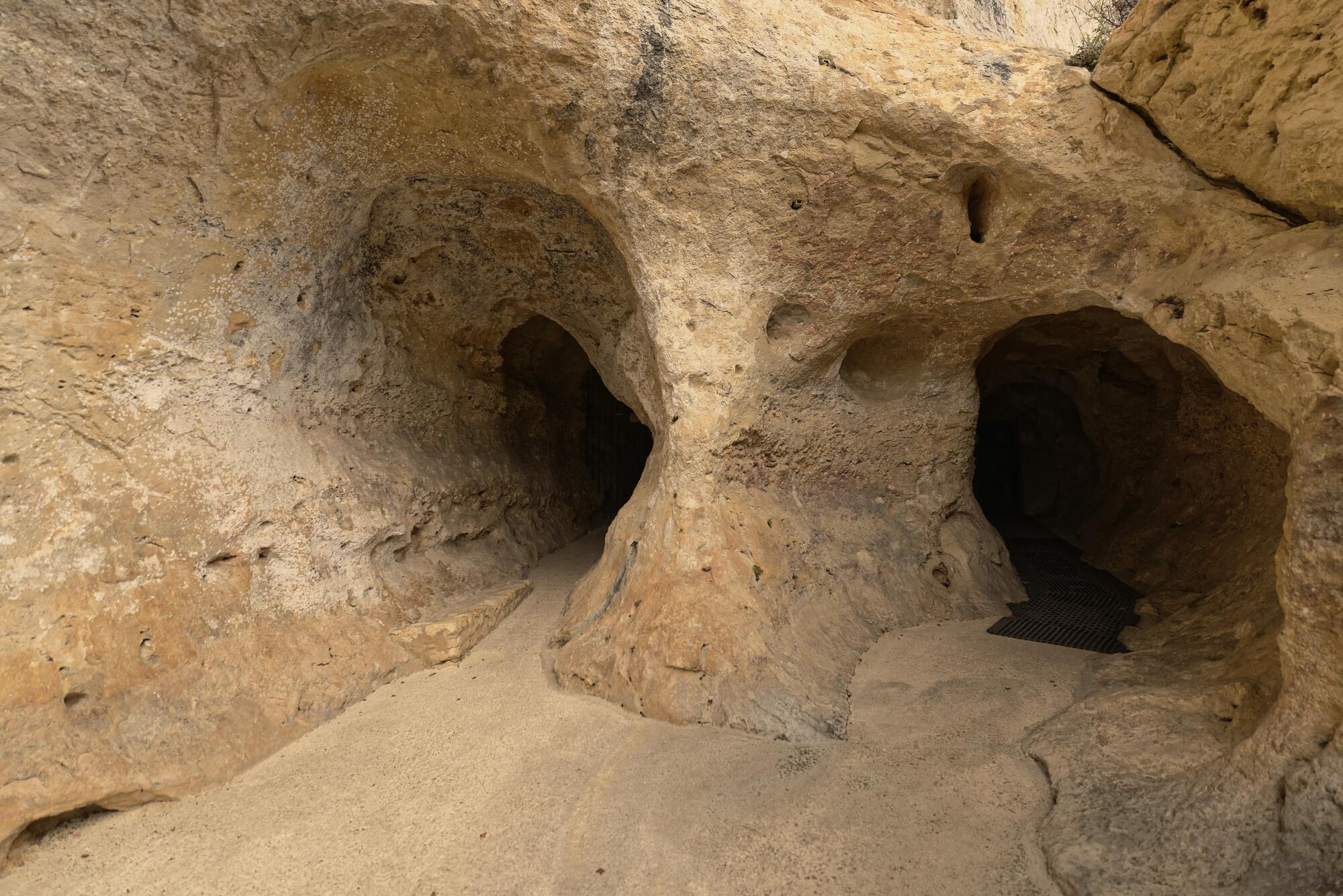

Although the objects found during the excavations can offer insights into the Magdalenian occupants of Font-de-Gaume, they do not allow us to formally date the prehistoric paintings. Caution is therefore required!
Remaining cautious
Generally speaking, it is very difficult to establish a clear relationship between the cave art and the archaeological context of a decorated cave, and even more so in the case of ancient works; more often than not, the object is proof that a place was frequented, not that it was decorated. Furthermore, during the cold season, there is little or no sedimentation to ensure that objects can be contextualised underground, unlike in rock shelters, which are subject to freeze/thaw cycles that encourage the accumulation of sediment and the preservation of remains. As a result, the artefacts left behind by humans, perhaps corresponding to millennia of use of the cave, may be found at the same level.
Finally, a decorated cave is not necessarily a dwelling, especially if it is deep: people have left evidence of their symbolic expression, but not of any domestic technical activities, except in close connection with the decoration: it’s a bit like excavating a church that has been abandoned for several centuries, looking for traces of daily life. The material is often limited, and while the pigments found at the foot of the paintings may have been used to create them, proof that they are indeed contemporary with the paintings is needed to be certain.
The chronological attribution of the objects found at Font-de-Gaume shows a very loose relationship with the direct dating of works — non-existent at Font-de-Gaume — and stylistic comparisons with pieces that are objectively more accurately dated. The objects found in the cave are often no more than signs of passage before, during and after it was decorated.
First visitors
The cave’s first occupants were cave bears: their tracks (scratches on the walls) and bones have been found in large quantities in certain peripheral areas of the cave, mixed in with a clay infill that in places is more than a metre thick. Humans — either the last Neanderthals or the first anatomically modern humans, a matter that is still subject to debate — sometimes accompanied them, leaving behind characteristic tools from this period (curved-backed points and flint knives from the Châtelperron period). Evidence of flint knapping can be seen on some bones: the men were able to recover skins, carcasses and sometimes canine teeth for jewellery.
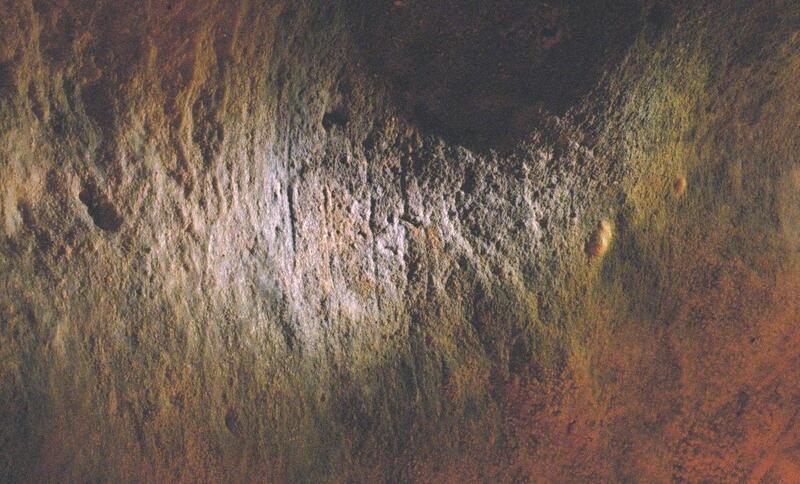
Bear claws, access gallery (© Ph. Jugie – CMN/CNP.)
Material left behind by modern man
As noted by Louis Capitan, Father Breuil and Denis Peyrony, the levels of occupation are concentrated, even merged together, in a thin stratigraphy (0 to 5 cm!), a thin layer of small blackish strata separated by a clay border, all of which is covered with pottery (in the decorated area, from the entrance to the crossroads and in the side gallery). Two small fireplaces, one at the end of the gallery, the other at the foot of the Rubicon, have never been dated.
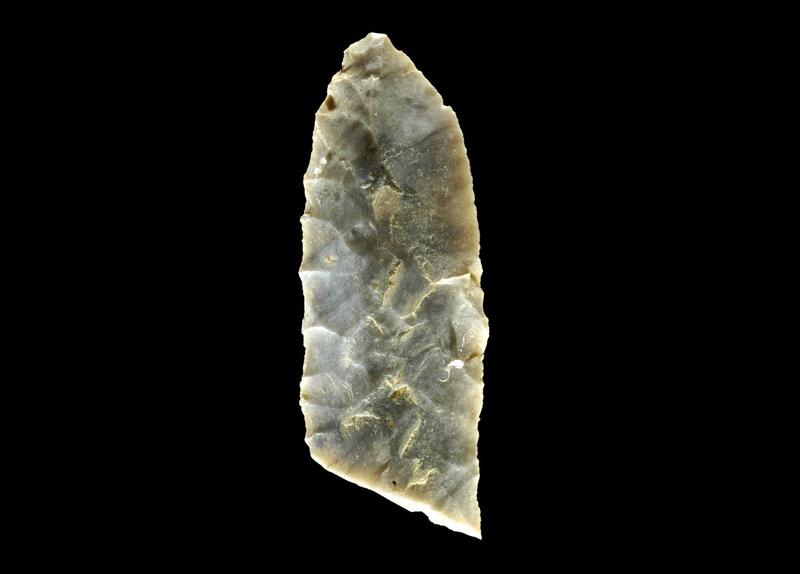
Attributable to the Upper Palaeolithic without being more precise than this, lithic tools on blades and fragments seem more typical of this period. A few scrapers and retouched pieces on blades could belong to the Aurignacian, although evidence of this period's characteristic bone industry has not been found. Unmistakable, however, are a point with a flat face and two fragments of a leaf-shaped Solutrean piece, around 20,000 years old, the time of Lascaux.
The material reasonably attributable to the Magdalenian, more or less contemporary with the paintings, seems coherent but is insufficient without any evidence of a characteristic bone industry, with the exception of a fragmented needle. This material comes mainly from the best-preserved sector, at the foot of the paintings, beyond the Rubicon. There were virtually no lamps, even makeshift ones: the cave was probably lit by torches instead. Fragments of dye, not very demonstrative, and lithic tools (burins, etc., more or less blunt) were probably used in decorating the cave, although no formal proof has been provided. A bone fragment engraved with a horse's head stands out as a clear indication that humans were present in the cave during the Magdalenian period.
Next slide
Previous slide
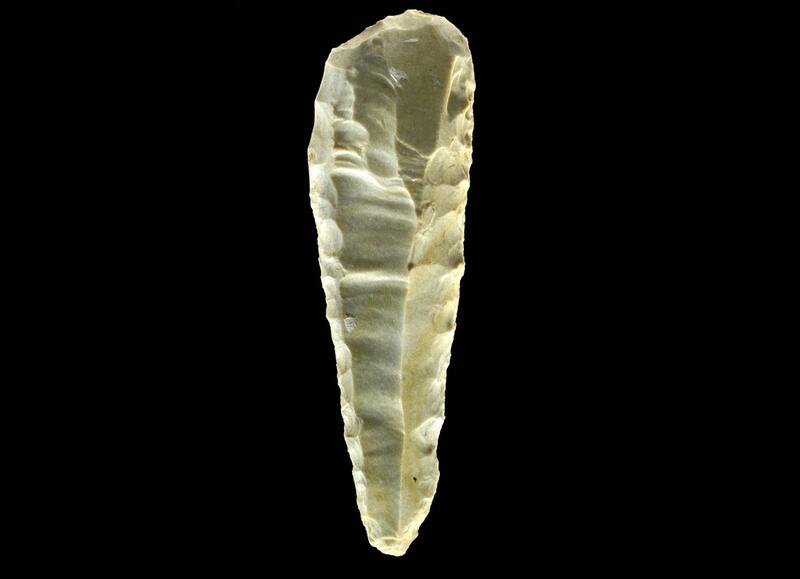
Scraper on an Aurignacian blade, excavated by François Prat. Les Eyzies-de-Tayac, National Prehistory Museum. (© Ph. Jugie – MCC/MNP.)
Fragment of a Solutrean retouched piece. Les Eyzies-de-Tayac, National Prehistory Museum. (© Ph. Jugie – MCC/MNP.)
Post-glacial presence (Neolithic to modern)
It is regrettable that material dating from recent prehistory to the modern era has traditionally been neglected in the region. Font-de-Gaume is no exception to the rule. Ceramic shards of all ages, both turned and unturned, were scattered throughout the different areas of the cave, alongside various fragmented bones of post-glacial fauna. A few human remains (skull fragments and long bones) can probably be attributed to the Bronze Age, with the discovery of a bone arrow shaft with a stalk and fins, and a fine bronze pin, providing evidence that the cave was used during this period.
