
Today, Font-de-Gaume is the subject of numerous scientific studies and digitisation projects, designed to explore the smallest details of the walls and open up the cave to a wider public.
Recent scientific studies
Over the last thirty years, Font-de-Gaume, our knowledge of which continues to be based on the 1910 publication, has also been the subject of various scientific studies. Denis Vialou carried out detailed surveys of the site that have never been done before. Norbert Aujoulat carried out an exhaustive study (prior to cleaning work) in the gallery before the Rubicon and confirmed that this sector, traditionally considered to be undecorated, had indeed been decorated 15,000 years ago, but sadly was in a very poorly preserved state (air currents, etc.).
Between 2007 and 2012, the MADAPCA programme led by Patrick Paillet and funded by the French National Research Agency developed new approaches to in situ micro-analysis. Since 2020, the same researcher, surrounded by a multidisciplinary team, has set himself the goal of re-evaluating the entire cave wall system.
Digitisation of the cave
Digitisation is a new means of accessing culture, supported by a national programme of the Ministry of Culture. The first 3D reconstruction of the Font-de-Gaume cave was made possible thanks to a partnership between the Archaeology Department (Centre national de Préhistoire) and the Centre des monuments nationaux, the body responsible for managing the site. The complete digitisation of the cave was carried out in 2012 in two successive stages, each of which was funded by one of the partners.
Today's technologies enable a reconstruction that is virtually identical to the original object, respecting the three X, Y and Z axes of space. 3D rendering can thus become a tool for scientific investigation, heritage management and dissemination.
Carrying out and constructing the 3D survey involved several methods and stages. Lasergrammetry, photogrammetry and full photographic coverage were used.
The stages involved:
- Recording a series of measurements in XYZ coordinates to produce a cloud of points.
- These points were linked together to form a network of triangles, known as a mesh.
- An artificial skin or, for greater realism, the photographed surface of the object, is then applied to this skeleton — this is called texturing.
Many variations (films, photos, plans, cross-sections, 3D prints, etc.) can be obtained from this creation.
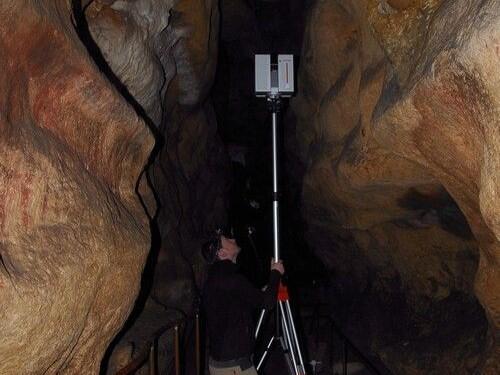

Taking measurements in XYZ coordinates using an HDS7000 scanner by Pérazio Géomètre eurl, January 2012. (© Michel Maumont – MC/CNP.)
Using a colour chart for the shots, March 2012. (© Art Graphique et Patrimoine.)
The decision to carry out a new digitisation of the cave and its external environment was made in 2022 following the call for projects "Digitisation of heritage and architecture" of the Investments for the Future Programme No. 4 (Programme d’investissements d’avenir n°4 [PIA4]).
Thanks to the use of cutting-edge techniques and equipment, a model of all the galleries in the cave, with a precision of less than a millimetre for the paintings, has been produced to meet conservation and research needs and to address new mediation challenges through the creation of an online guided tour.