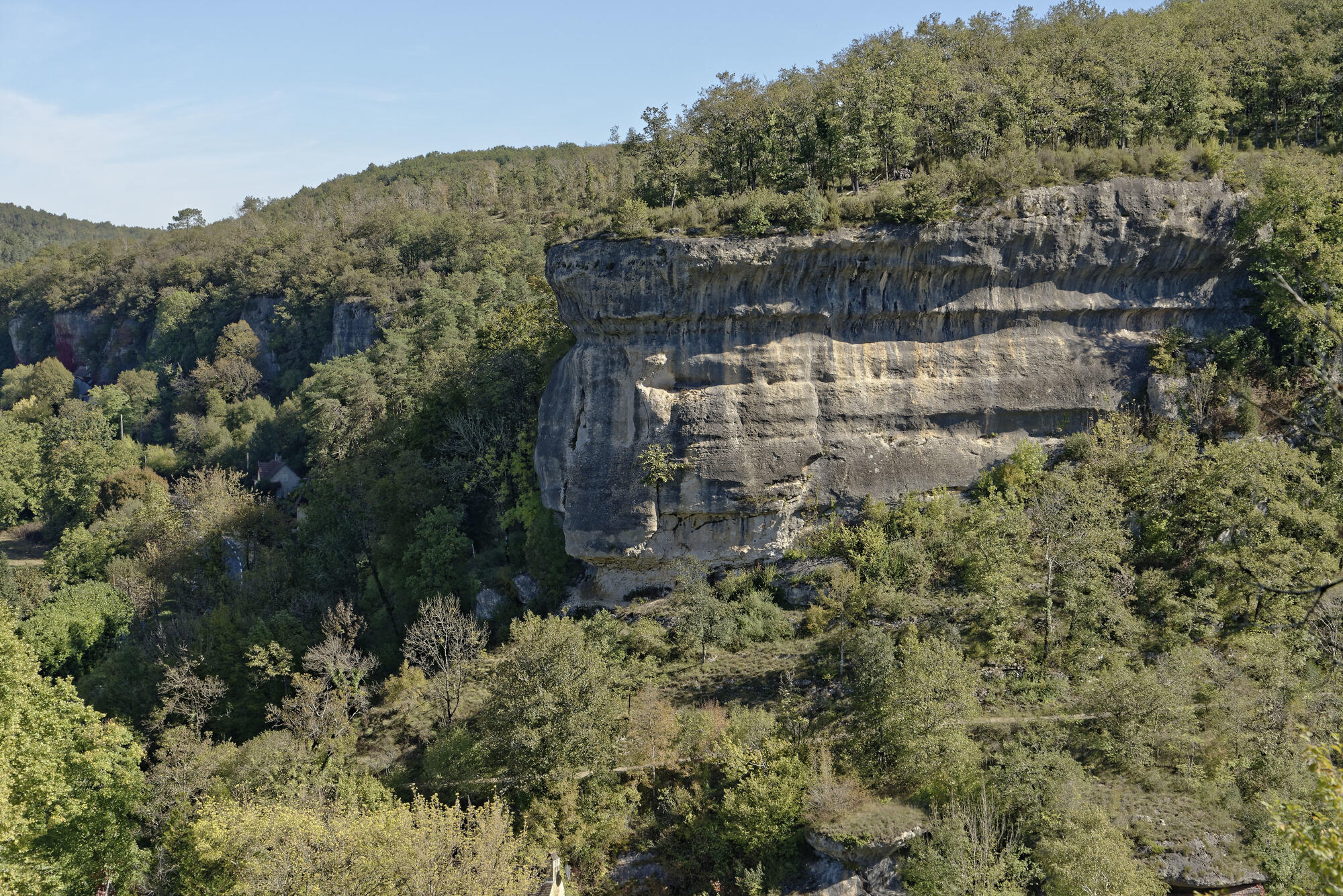

Carved out by erosion in a diaclase in the characteristic cliffs of the Périgord Noir, Font-de-Gaume is home to works of exceptional quality thanks to its depth and stable humidity. Only a few new localised concretions have affected the prehistoric iconography.
A cave that has remained open
It is set in limestone from the Mesozoic, which forms the iconic escarpments of the Périgord Noir landscape.
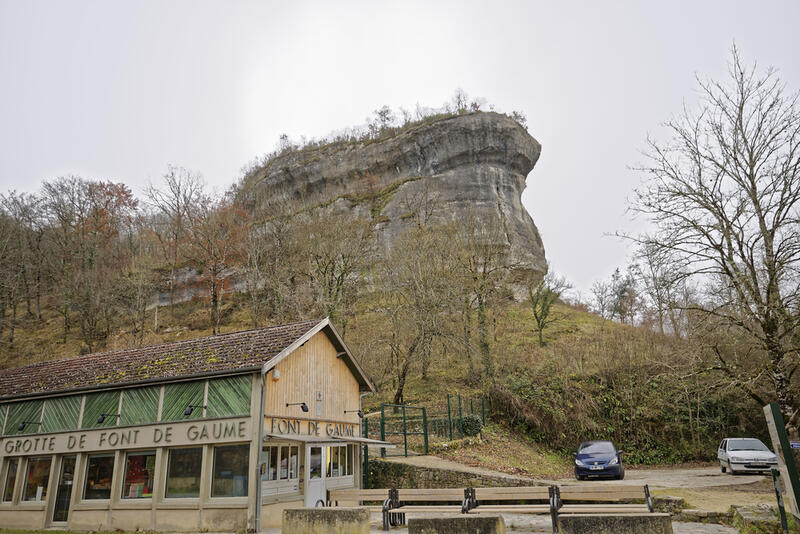
Its porch towers twenty metres above a small valley that opens out into the valley of the Beune, a tributary of the Vézère. With its clearly visible entrance, the cave was known for a long time before its prehistoric paintings were discovered in 1901. The network comprises a main gallery, around 120 metres long, which is connected to a number of diverticula: the Vidal, Prat and side galleries to the south; and the "little cave" to the north.
Next slide
Previous slide
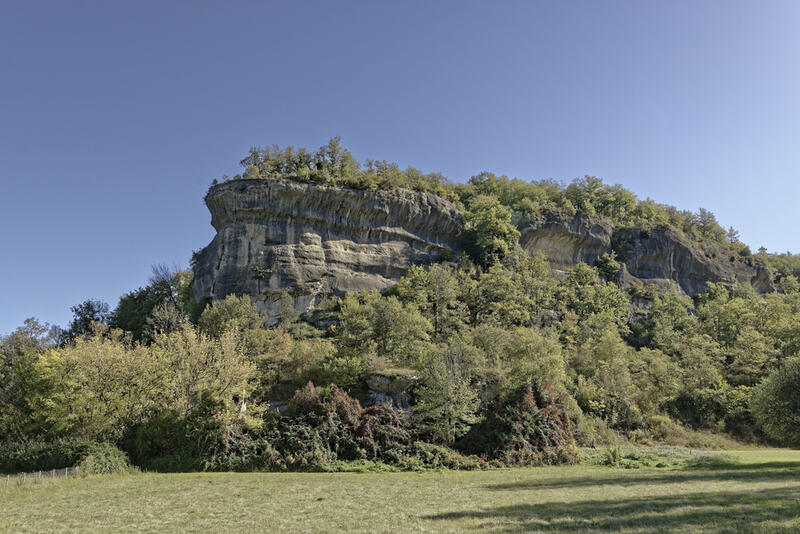
Rocky spur of the Font-de-Gaume cave (© Olivier Huard / Centre des monuments nationaux)
View of the Font-de-Gaume entrance area and rocky spur (© Olivier Huard / Centre des monuments nationaux)
Carving-out
The carving-out of the cave was guided by the diaclases, which explains the linear layout of the galleries, their height (from 1.60 to 3.80 m in the access gallery, up to around ten metres in the main gallery) and their narrowness (from 1.5 to 3 m wide with localised narrowings, such as the Rubicon). It can be traced back to the circulation of underground water, which caused the dissolution of the limestone, as shown by the softened morphology of the walls. Given the relative altitude of the network, it dates from at least the Middle Pleistocene, and may even have begun much earlier.
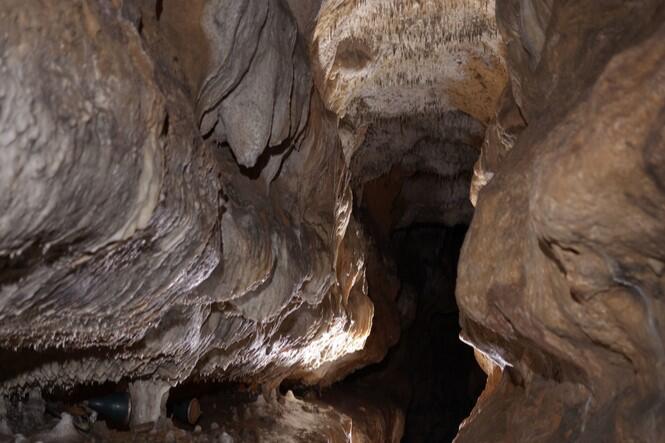
View of the high, narrow profile of the main gallery carved out of a diaclase (© Olivier Huard / Centre des monuments nationaux)
Infilling
The deposits that remain, which we walked over during the visit, are typically karstic. Only the top of these deposits has been excavated to a depth of 2 metres; this consisted of a succession of brownish sediments, alternating between clay-loam and sand, interspersed with stalagmitic floors. Some of these deposits were laid down during the last ice age, by alluviation, run-off and concretion, and reshaped in areas by cave bears. The presence of archaeological remains in these layers provides evidence of the first human occupation of the cave.

Cross-section of the accumulated sediment — at the foot of the right wall in the second section of the main gallery — showing the intercalation of a stalagmitic floor in clay-loam and sand deposits (© B. Kervazo – MCC/CNP.)
Preservation
The cave is deep enough to benefit from a stable temperature and humidity, which has helped to preserve the works. In addition, the walls have changed little since the Palaeolithic period, apart from new localised concretions, formed by the crystallisation of calcium carbonate contained in the water flowing through the surrounding limestone.

The Font-de-Gaume wolf, unevenly covered by concretions. (© D. Lafon and S. Konik – MCC/CNP.)
Associated media
Open Media Library