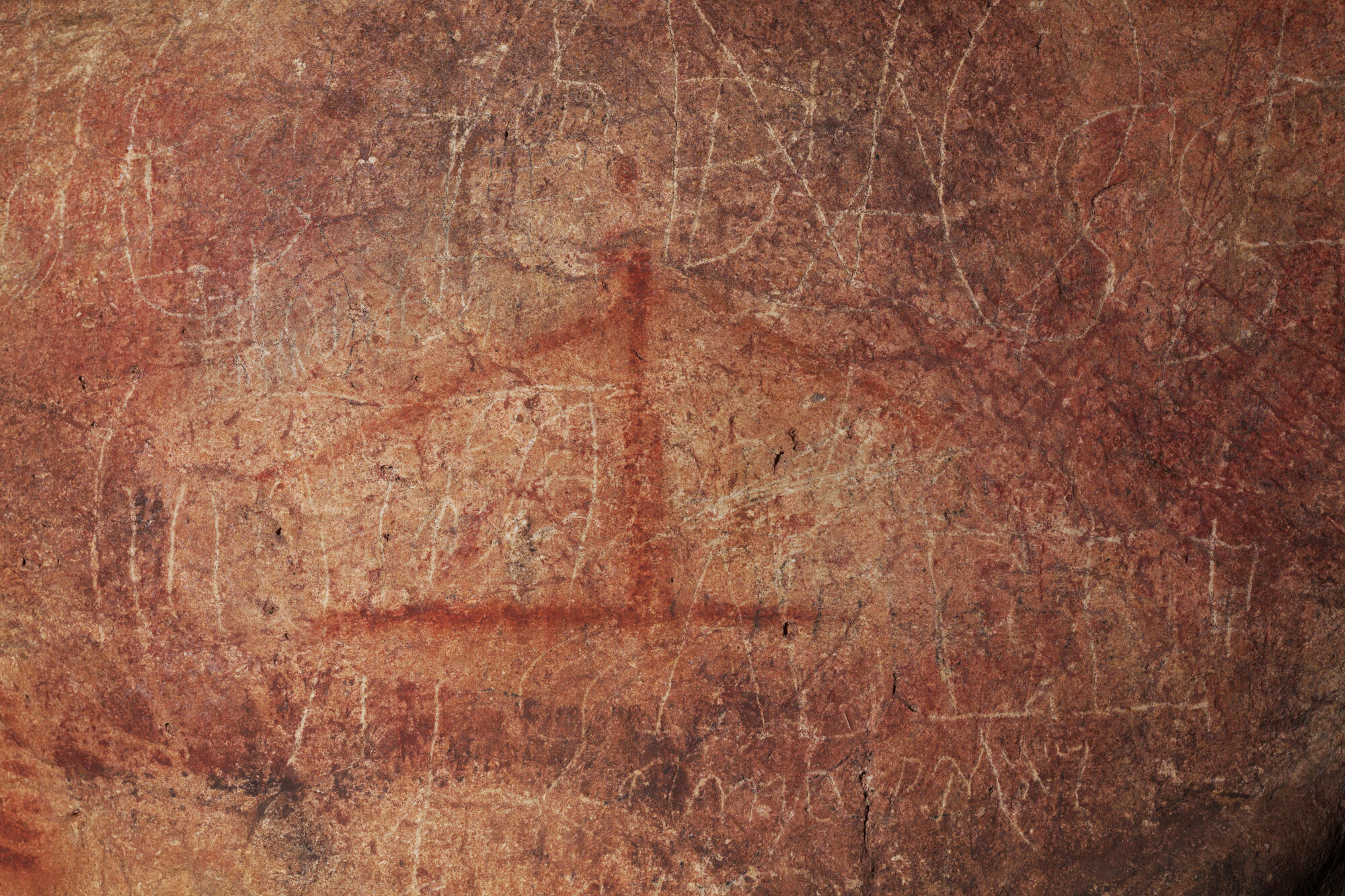

The mysterious painted or engraved symbols found on the walls of Font-de-Gaume and the three other Magdalenian caves in the region are as intriguing as they are fascinating. No one knows for sure what they are used for, but they seem to have a symbolic and identity-based meaning.
Depiction or symbol?
The tectiforme was named by Father Breuil at the beginning of the 20th century in reference to its shape, which resembles a roof. In those days, it was common to look for depictions of everyday objects in what we now call symbols. The tectiforme thus became a reference to huts or cabins, or even sometimes to the supposed trapping systems of Palaeolithic hunters.
Since the work of André Leroi-Gourhan in particular, the essentially symbolic and abstract value of these motifs has been recognised. Some have tried to view them as part of a system of writing, an alphabet of sorts, which would have accompanied the animal figures in the depths of the caves. However, no one has been able to decipher these motifs, whose value is undoubtedly determined as much by the shape itself as by its graphic environment and perhaps its location within the site.
Next slide
Previous slide
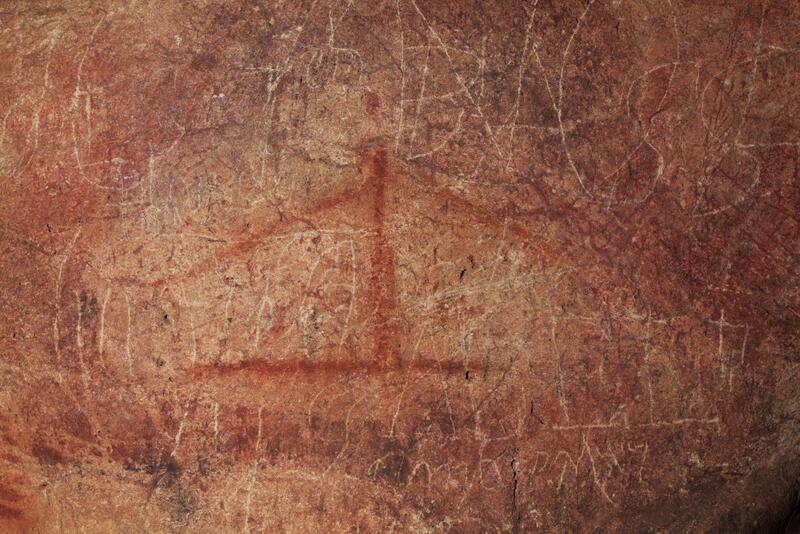
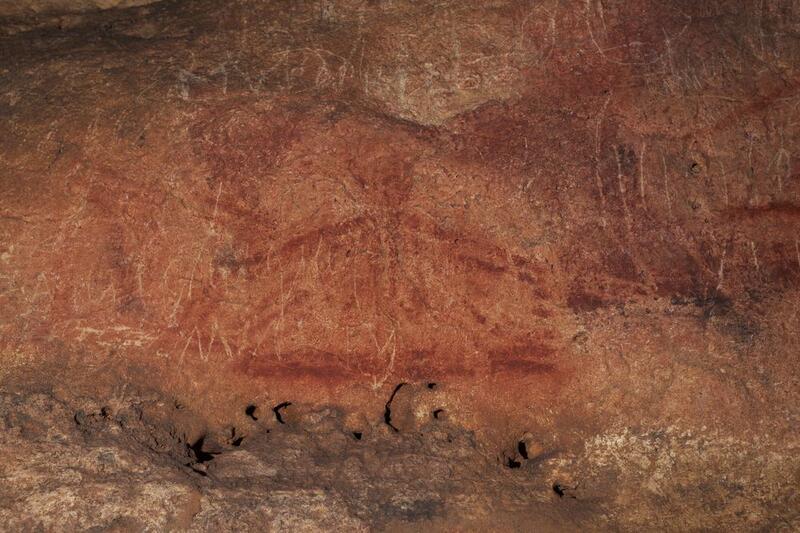

Red tectiforms, main gallery, left wall, first section. (© Olivier Huard / Centre des monuments nationaux.)
Red tectiforms, main gallery, left wall, first section. (© Olivier Huard / Centre des monuments nationaux.)
Engraved tectiform. (© Olivier Huard / Centre des monuments nationaux)
A marker of identity: the "tectiform caves"
Some of the symbols encountered in prehistoric art have a limited geographical and cultural distribution. This is the case for certain highly elaborate rectangular motifs known only in northern Spain, or the claviform, a club-shaped symbol found in decorated caves on both sides of the Pyrenees. The tectiforms, meanwhile, are found only in the Eyzies region, around Font-de-Gaume, and are associated with the Middle Magdalenian culture.
Only four caves contain this type of symbol. In addition to Font-de-Gaume, they can be found at Rouffignac, Combarelles and Bernifal. They do not exist at any other Magdalenian site in the region. This is why they are sometimes seen as markers of identity or ethnicity, a kind of "coat of arms", specific to a single human group that has left its own personal symbolic mark. It is surprising, however, that none of these symbols can be found on pieces of portable art that might have been made by the same human groups. This only makes these symbols, the deeper meaning of which we still don’t know, even more mysterious.
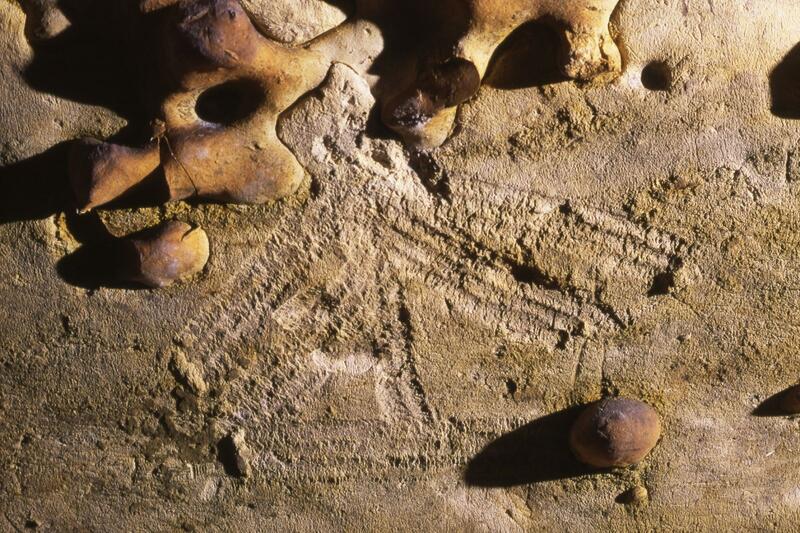
Rouffignac cave, tectiforme engraved in the gallery of the Great Ceiling (digital drawings), width 40 cm (© J. Plassard.)
Multiple expressions: variety in shape and technique
The tectiform symbol is always drawn in the same way at the different sites. The main element is the central pillar. It provides a perfect axis of symmetry and supports the "construction". It is often placed on a horizontal base and always topped by a roof. This is made up of two sloping sections. Sometimes, other vertical or oblique lines complete the pentagonal structure on either side. This basic design is sometimes made more complex by filling in the inner part of the symbol with lines or dots. In reality, despite a very high degree of similarity from one example to another, no two tectiform symbols are exactly the same. This is true both from one cave to another and within the same site. This variability in form therefore reflects a certain degree of freedom of expression, which can also take on symbolic nuances.
The techniques used to visually express these symbols are also highly varied. The tectiforms are often engraved with flint. On the softest substrates, they are sometimes sketched with fingertips or a simple stick. Elsewhere, they are finely drawn or painted with red pigment. One of the most remarkable symbols belonging to this category is undoubtedly that found at the back of the Bernifal cave, created by the juxtaposition of several hundred red dots of less than a centimetre in diameter. The catalogue of techniques used by artists is vast, but it is important to remember that the substrate itself is a limiting factor. A soft wall will lend itself to rough engraving with a finger or stick, but will be unsuitable for painting. Another will inspire painting rather than engraving. The inclusion of tectiform symbols in caves and on the specific substrate found therein reveals, in the same way as the other themes of Palaeolithic art, the extreme complexity of the symbolic behaviour underlying them.

