
The survey of the works inside the cave, carried out by Father Breuil in 1903, led to the production of a monograph of exceptional editorial quality, presenting the various paintings together with in situ observations.
In 1903, Father Breuil began carrying out a systematic survey of the Font-de-Gaume cave. He worked using direct tracing, pressing a large sheet of glassine paper against the wall. This first drawing was reduced to 1/5 of its size using a light camera, then finished opposite the original, in Indian ink for the engravings and in pastel for the paintings. These materials, together with a wealth of observations gathered in situ, were intended to be published in a monograph.
This monograph, entitled La Caverne de Font-de-Gaume aux Eyzies, was published in 1910 under the names Capitan, Breuil and Peyrony. A work of high editorial quality, it was only made possible thanks to the patronage of Prince Albert I of Monaco. It formed part of a larger publication project contracted in 1904 between several researchers, including Breuil and the Prince, covering all the decorated caves known at the time. The first volume, published in 1908, focused on Altamira (Spain). For Breuil, Font-de-Gaume was a logical follow-up, given the similarity between the works in the two caves.
The monograph
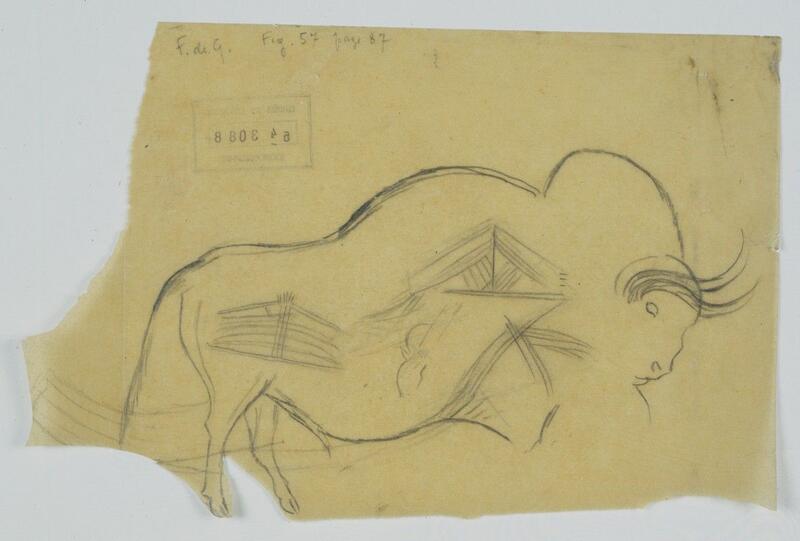

Bison from the Font-de-Gaume cave, sketch by Father Breuil, circa 1903–1905. Paris, main library of the Muséum national d’Histoire naturelle, Breuil iconography collection, no. 54 3088 (© Bibliothèque centrale MNHN, Paris 2012.)
Bison from the Font-de-Gaume cave, coloured on paper by Father Breuil for the publication of the 1910 monograph. Paris, main library of the Muséum national d’Histoire naturelle, Breuil iconography collection, no. 54 1893 (© Bibliothèque centrale MNHN, Paris 2012.)