
Nothing is left to chance on the wall of Font-de-Gaume. The figures in the two tiered levels are symbolically arranged throughout the cave. The bison are thus given pride of place and represented in the main arrangement
Omnipresent iconography
The main images are arranged in two large tiered levels, one at standing height, the other higher out of reach (over 3 m); some of the drawings are also spread out at ground level. This use of space is not uncommon, and suggests the use of devices or aids to reach inaccessible areas.
The arrangement of parallel bands is an adaptation to the linear morphology of the main gallery and its relative narrowness.
The manual field is the surface area that lies within the artist's reach without them having to move their body. In fresco work, this limitation is often surpassed, requiring use of the whole body.
Arrangement of the decoration
The main arrangement gives pride of place to the bison, which take up the entire space. Mammoths are more likely to be found at the beginning. Cervids and horses are intermittently depicted throughout the cave, usually in groups. Rare species — felines, rhinoceroses, bears — appear at the end of the galleries. The same applies to anthropomorphs and bovids. The tectiform symbols are located on the left wall in the Rubicon antechamber, in the main gallery and in the Chamber of the Bison. Only three of these are found in the end diverticulum.
A distinctive distribution can thus be seen in the themes. Conversely, the space itself has no bearing on the technique chosen. All of the galleries have been decorated, alternating between large staged compositions and drawings placed in narrow, more intimate areas that are difficult to access.

Before the Rubicon
The access gallery was thought to be undecorated until the early 1980s, when Alain Roussot, Norbert Aujoulat and Paulette Daubisse discovered the remains of decoration 25 metres from the entrance. However, the silhouette of a red mammoth could be seen among the now uninterpretable markings. In the Rubicon antechamber, in addition to a red circular symbol, the first engravings feature tectiforms, horses and bison associated with clusters of lines.
The Prat gallery features, on the left-hand wall only, unfinished red, purple and black drawings of horses, mammoths and possibly a goat.
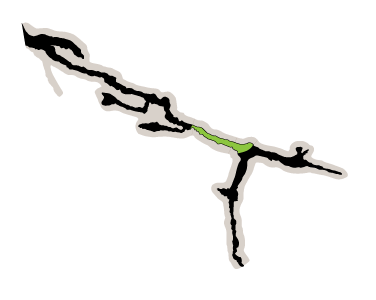
The first section of the main gallery
It is beyond the Rubicon that most of the decoration begins, spread over the two walls of the main gallery, the crossroads, the side gallery and the end diverticulum. The density is highest at the beginning of the main gallery, where the major works are grouped together. The best-preserved bison are found in the second section of the left wall. The themes run parallel along the two walls, and the compositions and techniques are similar. The layout is the same, in two tiered levels, with cohorts of polychrome bison, mammoths and deer in the main group. Two black negative hands can be seen under a low overhang on the right-hand wall, as well as two or three other probable hands on the right wall. All techniques are used in this sector, but engravings, particularly of mammoths, are more prominent on the left wall of the main gallery.
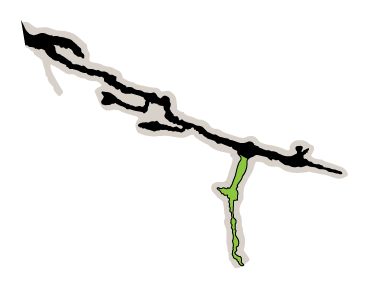
Side gallery
This gallery, which is in a poorer state of preservation than the main gallery, opens up on the right. Heavy concretion at its entrance makes it difficult to see what must have been, for the most part, bison. The animal featured most prominently in this gallery is the horse on the right wall; the left wall combines bison and reindeer. Towards the end of the gallery, after a number of narrowings, you can crawl into a new space where figures can still be seen on the left wall. They are difficult to see: goat, deer and, most notably, the vertical silhouette of a red bear. The whole of this sector is covered with isolated or grouped dots, bars or lines. Some of the graphics combined with the natural relief call to mind masks or animal heads. At the end of the gallery, there are two black paintings that are difficult to interpret.
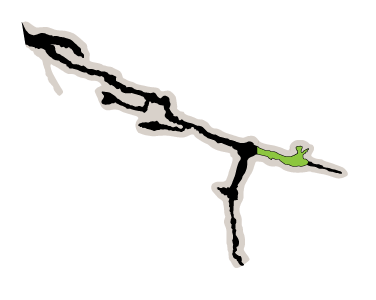
End of the main gallery
Emerging from the side gallery, you walk through the second section of the main gallery. Its left wall is hollowed out to form a round space – known as the Chamber of the Bison – which was chosen as the location of a dense rotating composition of a dozen bison, drawn after a glaze of red ochre was seemingly applied. It appears that a play on the colours of the animals divides the space into three levels: black in the upper sections, browns in the area in the middle and polychromes at the bottom. Numerous clusters of engraved lines and tectiforms preceded the bison. Protomes of horses and aurochs add to the dominant composition.
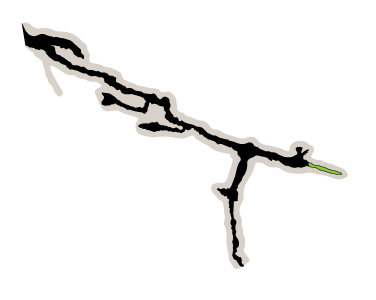
End diverticulum
Beyond the Chamber of the Bison, the end diverticulum continues, a narrow area that is nonetheless mostly decorated with a rhinoceros drawn in red lines, three tectiforms and a feline facing the final group of seven engraved horses.