
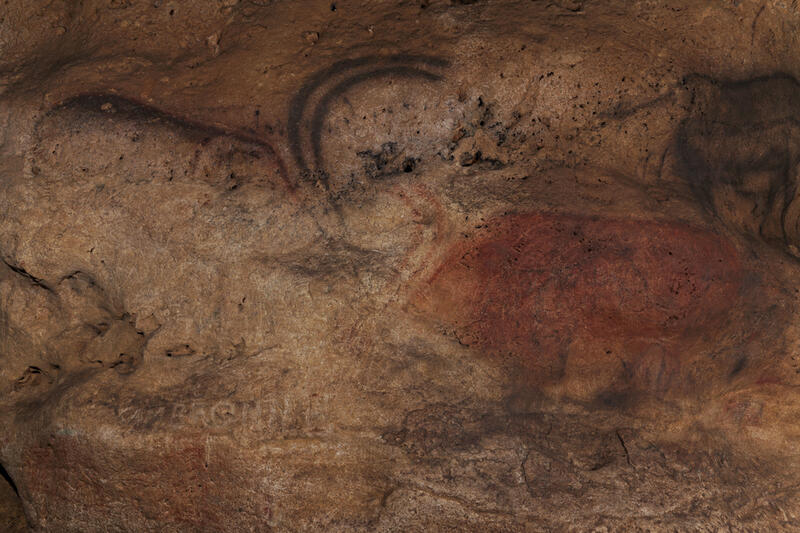
Bison
For polychrome bison, certain constants are apparent. The contours are drawn in a shaped black band and the figure is filled in with a brown tint, with a sfumato effect between the different colours. Areas of unpainted rock help to create the appearance of volume. Finally, engraving or scraping sharpens the overall contours by defining a clearer boundary and creating a stronger contrast with the substrate. Engraving is also used to draw the internal elements: horns, eyes, folds of the groin or elbow, etc. Note that this engraving work is so complete that if the paint were to disappear, the figure would still be perfectly clear.

Bison, main gallery, right wall (© N. Aujoulat – MCC/CNP.)
Deer
For deer, the conventions are a little different, with red dominating and blacks more subtle. However, there is always a contrast between the edges of the figures and the colour used to fill them in. The legs and horns are also in the opposite colour to make them stand out. Lighter areas are often included to indicate where the light hits the animal.
Reindeer facing each other in polychrome, main gallery, left wall, first section. (© O. Huard / Centre des monuments nationaux)