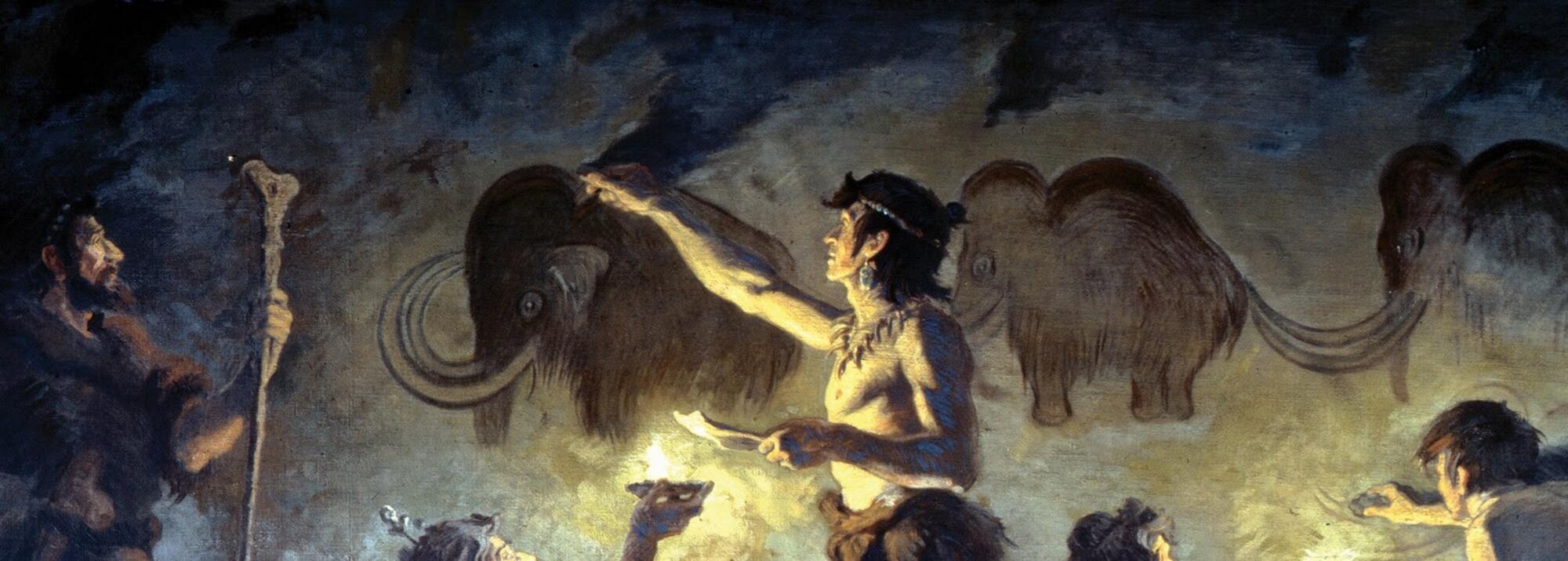

Successive excavations at Font-de-Gaume have led to the discovery of a number of works of portable art, providing evidence of the strong link, both stylistic and symbolic, between the objects and the cave art.
A work of portable art at Font-de-Gaume
An engraved bone was discovered by Henri Breuil in the main gallery of the cave, near the Rubicon. Published in 1910 in the monograph on the cave, it is now kept at the National Archaeology Museum in Saint-Germain-en-Laye (Yvelines). It may be a fragmented vertebra, engraved with a horse’s head. The survey carried out by Breuil does not really correspond to the original. In fact, all you can see is the outline of a head and a few lines suggesting a mane. The rest of the animal can be seen in the shape of the substrate itself.
Its connection to the cave art is difficult to establish. The direct relationship between portable art and cave art within the same site is rare in the region's decorated caves. At Font-de-Gaume, the evidence is therefore exceptional, even if it cannot be interpreted with any degree of precision.
Portable art and cave art: a cultural link
There is a strong link between cave art, which is generally monumental but often secret, and the art seen in objects, which formed part of people's everyday lives. By different means, and no doubt pursuing different objectives, people have expressed their symbolic and intellectual world through engraving, painting and sculpture.
The themes represented are similar: a large majority of symbols and animals, and a few humans. Differences in the number of animal species are sometimes seen: reindeer are more common on objects and bovines are more numerous on walls. In reality, the differences in themes are more related to the periods and geographical areas in question.
The presence of portable art at Font-de-Gaume serves as exceptional evidence of this special relationship. There are very few decorated sites (caves or shelters) at which decorated objects have also been uncovered. The reciprocal cultural proximity of these art forms is very rarely demonstrated. In contrast, we believe that the same populations frequented sites with different functions in a given area: places of habitation, burial sites or decorated caves.
Associated media
Open Media Library