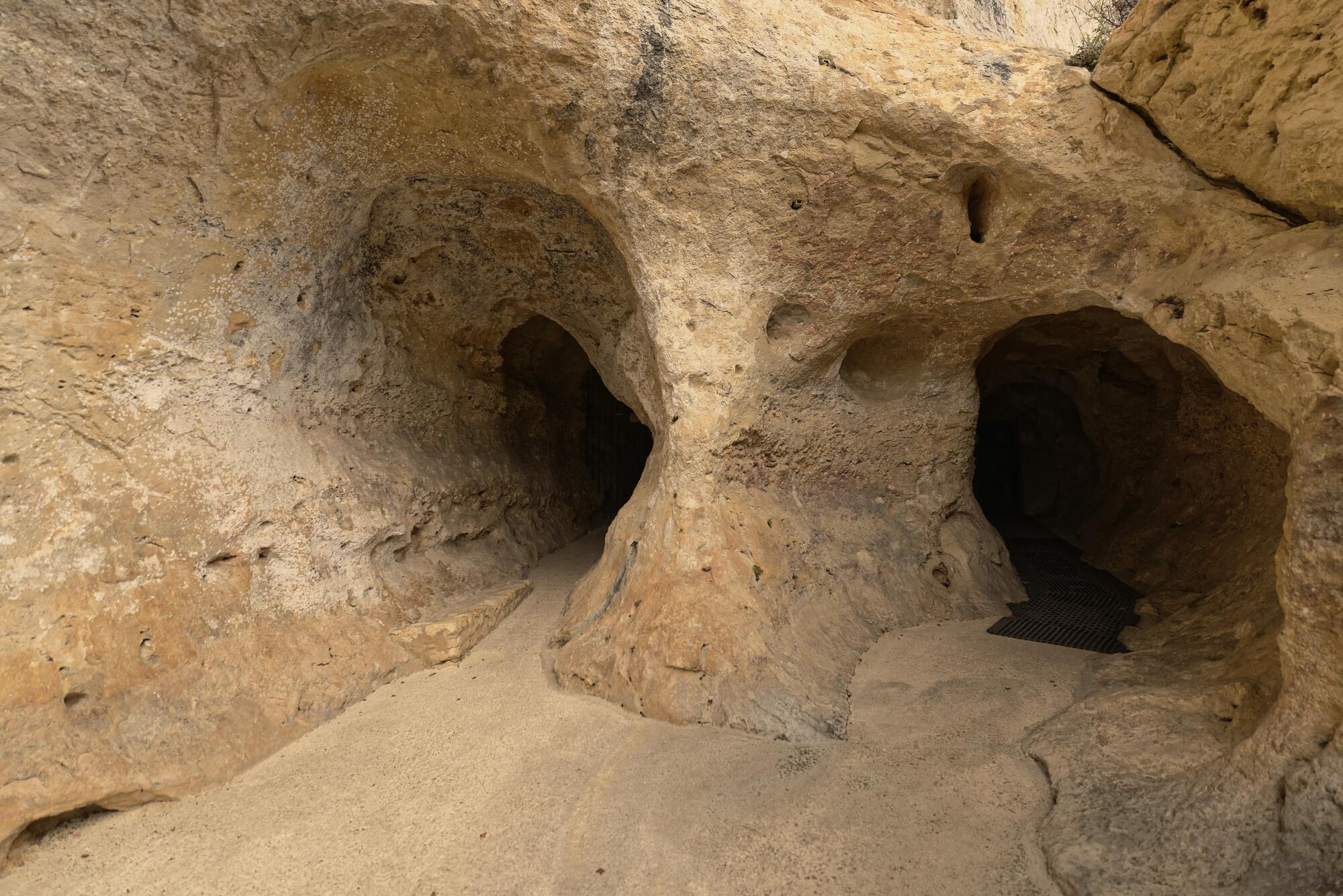

Entrance porch to the cave (© Olivier Huard / Centre des monuments nationaux).
On the upper part of the wall you can see the holes used to wedge in the structural beams.
Inside the cave
Inside the cave, archaeological information has been gathered under a wide variety of conditions: isolated finds, development and protection work, or actual archaeological work. Well-documented pieces, acquired by scientific method, are rare.
The conservation of these archaeological discoveries at the National Prehistory Museum in Eyzies-de-Tayac (Dordogne) and National Archaeology Museum in Saint-Germain-en-Laye (Yvelines), fortunately allows them to be re-examined for possible new analyses.
Very soon after its discovery, work was carried out to develop and protect the cavity in order to reconcile opening it up to the public with ensuring the safety of the works: acquisition by the state, closure by a gate, then a door, successive electrical installations (1920 and 1973), lowering of the ground in the main gallery (1951), lowering of the ground in the second section of the main gallery (1967–1968), installation of an air extraction system (1973) and reorganisation of the pathway (1999–2000). In many cases, this work led to the collection of archaeological material: several hundred objects are now held together at National Prehistory Museum, unfortunately without any precise record of their origin or context.
It should also be borne in mind that some of the cave walls have also been cleaned in localised areas (in 1966, 1993 and 1998), which may interfere with the analysis of the works or the materials used to produce them.
As far as scientific work is concerned, artefacts were collected from the cave floor after the paintings were discovered. They are mentioned in the 1910 monograph (La Caverne de Font-de-Gaume aux Eyzies [Dordogne]): objects were collected in the access gallery (ceramics, flint tools), the Vidal gallery (ceramics from various periods, animal bones), the Prat gallery (flint tools, animal bones), at the foot of the Rubicon (ceramics, flint tools), at the junction between the main gallery and the side gallery (dyes and a needle fragment), in the main gallery (engraved bone, pieces of reindeer antler, flint objects), in front of the Chamber of the Bison (flint and bone tools, animal bones) and in the side gallery (animal bones, flint objects).
This list includes a total of 77 items, described by Louis Capitan,Father Breuil and Denis Peyrony, who also carried out the first archaeological surveys: one in the small cave, the other in the Prat gallery. The first uncovered a jumble of artefacts dating from between the Middle Palaeolithic and the Middle Ages. The second, at the top of the "bear clay", revealed a small fireplace from the Upper Palaeolithic.
François Prat, professor of palaeontology at the University of Bordeaux I, undertook excavations in the second side gallery — which became the "Prat gallery" — between 1958 and 1964, then in the second section of the side gallery in 1967–1968. These two sites, known respectively as Font-de-Gaume I and III, have revealed several archaeological levels, the main ones being:
- a reworked level containing remains from the Upper Palaeolithic (A-B-C and layer 3);
- one or more clay levels containing numerous bear bones (K-L-M-N and layers 4 to 5) and, in localised areas, tools from the Chatelperronian;
- an old stalagmitic floor, still containing a few bones in its upper part, then none in the deepest levels (from O to V and layers 6 to 8).