Origins in the early Lower Palaeolithic
The hominid lineage began its adventure around 10 million years ago in central and western Africa, around 6 to 7 million years ago. The classic australopithecine group, found mainly in South Africa, shows us that our arboreal ancestors were present from 4 to 5 million years ago. A decisive step was taken around 3 million years ago, when hominins acquired perfect bipedalism and the ability to make carved stone tools. Armed with these two assets, the first real humans began by populating the entire African continent, before setting out to conquer Eurasia. This first departure from the cradle of origin, by Homo ergaster, whose general morphology was already modern (cf. the Turkana adolescent, "Nariokotomé boy") despite a fairly small cranial capacity (around 850 cm3, around 1.8 million years ago), was confirmed by the discovery of human fossils from Dmanissi (Georgia, 1.7 million years ago) linked to faunal remains and lithic industry. This marked the beginning of the early Lower Palaeolithic period, when the first humans were essentially collectors of plant and animal proteins, scavenging on prey left behind by large carnivores. In western Europe (Spain, Italy and France), and contrary to popular belief, based on sites in the Massif Central, the first settlements do not seem to have appeared before 1.2–1.4 million years ago, in a generally warm and humid climate, with a fauna inherited from the Tertiary era. Little is known about their way of life, which consisted of harvesting animal carcasses with rudimentary lithic tools, open-air sites with little structure, and using lithic raw materials gathered in the immediate vicinity of the sites.
Next slide
Previous slide
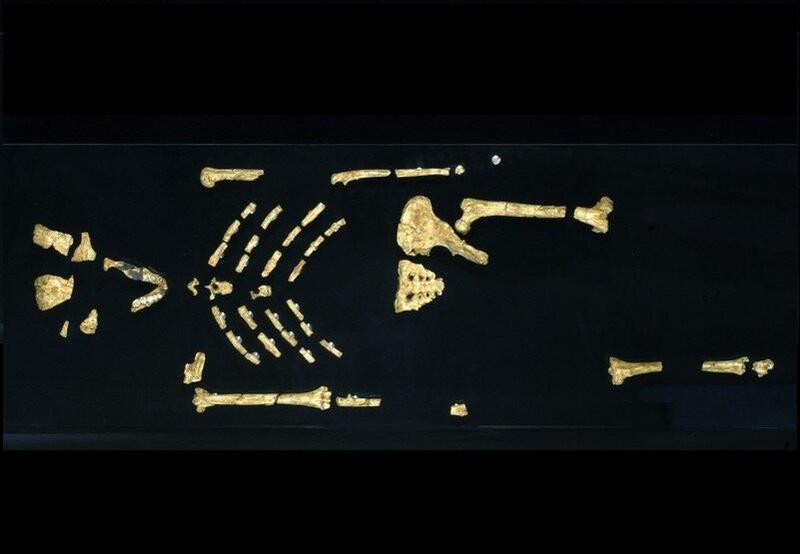

Australopithecus, "Lucy" skeleton cast. Les Eyzies-de-Tayac, National Prehistory Museum. (© Ph. Jugie – MCC/MNP.)
Homo ergaster, skull cast from Dmanisi (Georgia). Les Eyzies-de-Tayac, National Prehistory Museum. (© Ph. Jugie – MCC/MNP.)
The Lower Palaeolithic
The reversal of the Earth’s magnetic polarity, around 780,000 years ago, coincided with fundamental changes. The climate, which was much colder, changed regularly, with much shorter climatic cycles (around 100,000 years); the Quaternary faunas from which modern faunas originate were gradually becoming established. Significant progress was made during this Lower Palaeolithic period: humans lived in small, organised groups, and began to settle in caves or shelters, which helped to preserve their remains. In Europe, much later than in Africa, elaborate lithic tools were made from fragments, associated with the first very characteristic bifaces around 600,000 years ago. These were fully versatile tools that suggest that their perfectly symmetrical shape had been planned in advance, a major intellectual advance. Man became a true predator, hunting large herbivores in groups and discovering a richer and more varied diet. Homo erectus also practised cannibalism (Tautavel, Pyrénées-Orientales). In Eurasia, several human types appear to have coexisted, one of them being the ancestor of the first Neanderthals, which emerged during the Middle Palaeolithic, between 300,000 and 30,000 years ago.

Tool from the Lower Palaeolithic found at Escout (Pyrénées-Atlantiques). Les Eyzies-de-Tayac, National Prehistory Museum. (© Ph. Jugie – MCC/MNP.)
The Neanderthal period
Neanderthals occupied the northern Mediterranean basin, from Spain to Iraq, and were initially best known for their tools, which combined a few highly geometric bifaces with an abundance of elaborate and highly diversified flake and even blade material, as well as the first wooden objects (where this material was preserved). These early sapiens, hunters of large herbivores, differ morphologically from modern man (Homo sapiens sapiens). We know from their way of life that they lived in small family groups, capable of taking care of the weakest, that they liked to live in shelters and that they had a fairly limited territory (50 to 100 km maximum). They share with anatomically modern man the achievement of a major milestone for humanity: the acquisition of symbolic expression in the context of burials, as Neanderthals began to bury their dead after 100,000 years, with elaborate rituals and offerings implying awareness of an afterlife.
After 250,000 years of undivided reign over Western Europe, Neanderthals disappeared, perhaps after living alongside anatomically modern man for a time, acquiring new technologies and producing hybrid offspring.

Skeleton of a Neanderthal child discovered at Roc de Marsal (Campagne, Dordogne). Les Eyzies-de-Tayac, National Prehistory Museum. (© Ph. Jugie – MCC/MNP.)
Modern humans
Modern humans marked the beginning of the Upper Palaeolithic, around 38,000 years ago. They lived in a predominantly glacial climate, in organised, hierarchical groups, and likes to frequent shelters and caves. Their technology was extremely sophisticated, with highly specialised laminar and even lamellar lithic tools and a brilliant bone, ivory and antler industry. Nomadic, they exploited a fairly vast organised territory according to the seasons and were capable of long-distance travel; reindeer hunters, fishermen, gatherers, they were already developing techniques for preserving food and building up stocks, which would enable them to develop a new form of symbolic expression, portable art and cave art, on a large scale, over and above the jewellery that undoubtedly reflected a hierarchical society.
The predominantly animal-based art, which also included numerous geometric symbols, undoubtedly ethnic markers, started to develop in the Aurignacian (Chauvet cave), and continued through the Gravettian (Pech-Merle, Pair-non-Pair) and Solutrean (Roc-de-Sers, Fourneau-du-Diable) right through to the Magdalenian (Lascaux, Font-de-Gaume, Combarelles, Cap-Blanc), at which point both cave walls and objects made of reindeer bone and antler, both utilitarian and otherwise, were literally covered with such art. This was the apogee of glacial art, the marvellous remains of which disappeared very quickly, from 10,000 years ago, with the arrival of a more temperate sub-current climate.
Next slide
Previous slide


Points from Gravette, tools from the Upper Palaeolithic. Les Eyzies-de-Tayac, National Prehistory Museum. (© Ph. Jugie – MCC/MNP.)
Bison licking its flank carved in antler, found at La Madeleine, Tursac (Dordogne). Les Eyzies-de-Tayac, National Prehistory Museum. (© Ph. Jugie – MCC/MNP.)