
Men and women of salt
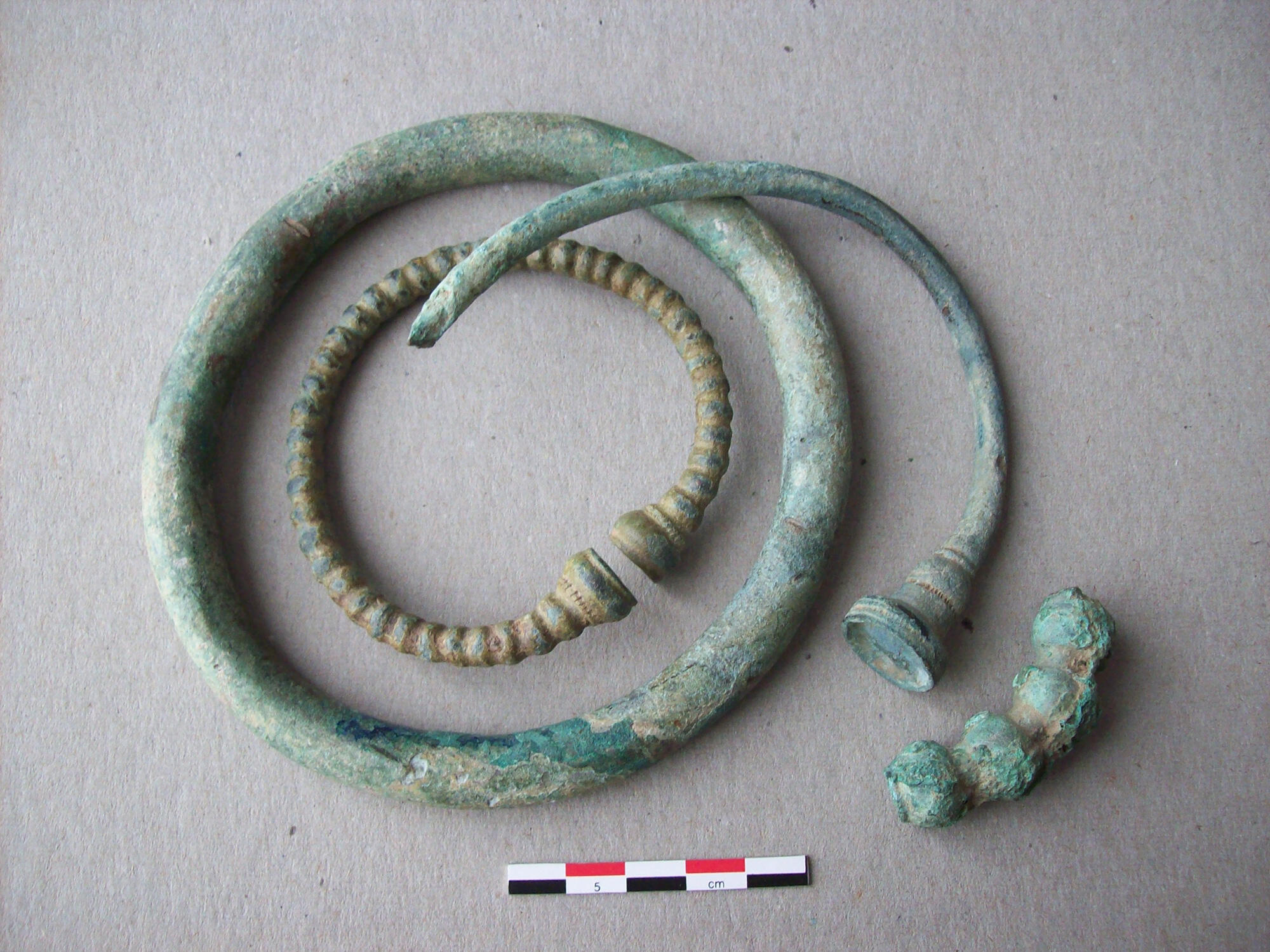
The work of Celtic saltworkers was divided up according to gender. The preliminary treatment of the brine was clearly carried out by adult women, who regularly lost some of their jewellery in the process, such as solid black rock rings or, more rarely, amber beads.
The men were assigned to building and maintaining the furnaces. They left deer antler picks near the work areas, which were probably used for digging out the heating chambers or replacing the loading grates for the salt moulds.
The types of jewellery lost by the saltworkers are associated with burials belonging to those of higher social status in the surrounding burial mound necropolises, such as "Bois de Voivre" in Haroué or "La Naguée" in Clayeures (Meurthe-et-Moselle). Their presence indicates that a population of privileged status operated the salt-making workshops during the Celtic period.
Jewellers, blacksmiths and weavers
Excavation of the "la Digue" workshop area in Marsal has provided us with a sketch of these large rings with a D-shaped cross-section, which shows that these pieces of jewellery could have been made at that same location. Several of the pieces abandoned or lost in the basin area had been repaired, no doubt on site. The origin of the raw material, extracted from marly limestone, remains unknown.
At "Burthecourt" in Salonnes, a terracotta crucible, as well as forge slag and scalings, have been discovered in the residential area next to the salt-making workshop. These remains of metallurgical activity indicate that saltworkers in the 6th century BC produced small bronze objects as well as finished iron objects, using imported raw materials. Spindle whorls and a loom weight were also discovered at the "Burthecourt" workshop area. Spinning and weaving were therefore also practised by the communities of saltworkers.
Two deposits of iron ingots were discovered among the large accumulation of briquetage in the town of Marsal. They were made up of bi-pyramidal pieces: the first deposit contained a set of eight ingots arranged side by side, while the second contained a series of 19 pieces arranged in two rows in an alternating pattern. This discovery confirms that raw iron reached the salt production sites in the Seille valley during the Iron Age.
Feeding the saltworkers
Celtic salt-making communities grew five types of wheat, including barley in particular, but also spelt, emmer, millet and einkorn. They are hardy species, adapted to poor soils and resistant to climatic variations. The saltworkers also grew lentils in winter, as well as oil-producing plants such as camelina and opium poppy. These cultivated crops were supplemented with hazelnuts, sloes and wild strawberries.
The saltworkers ate mainly beef, pork and mutton, while horse and dog were eaten only occasionally. Rare evidence of them having eaten chicken has been found at the "Pransieu A2" workshop in Marsal. Sulphur and strontium isotope analyses show that some of the livestock — in particular pigs — may have been of non-local origin.
The remains left at the site of the salt-making workshops are butchery waste, linked to the preparation of the carcasses. The meatiest parts (such as the shoulder or the shank) were generally absent, while the most frequently discovered parts were those that would have had the least meat on them — such as the lower legs and parts of the spine or skull.


