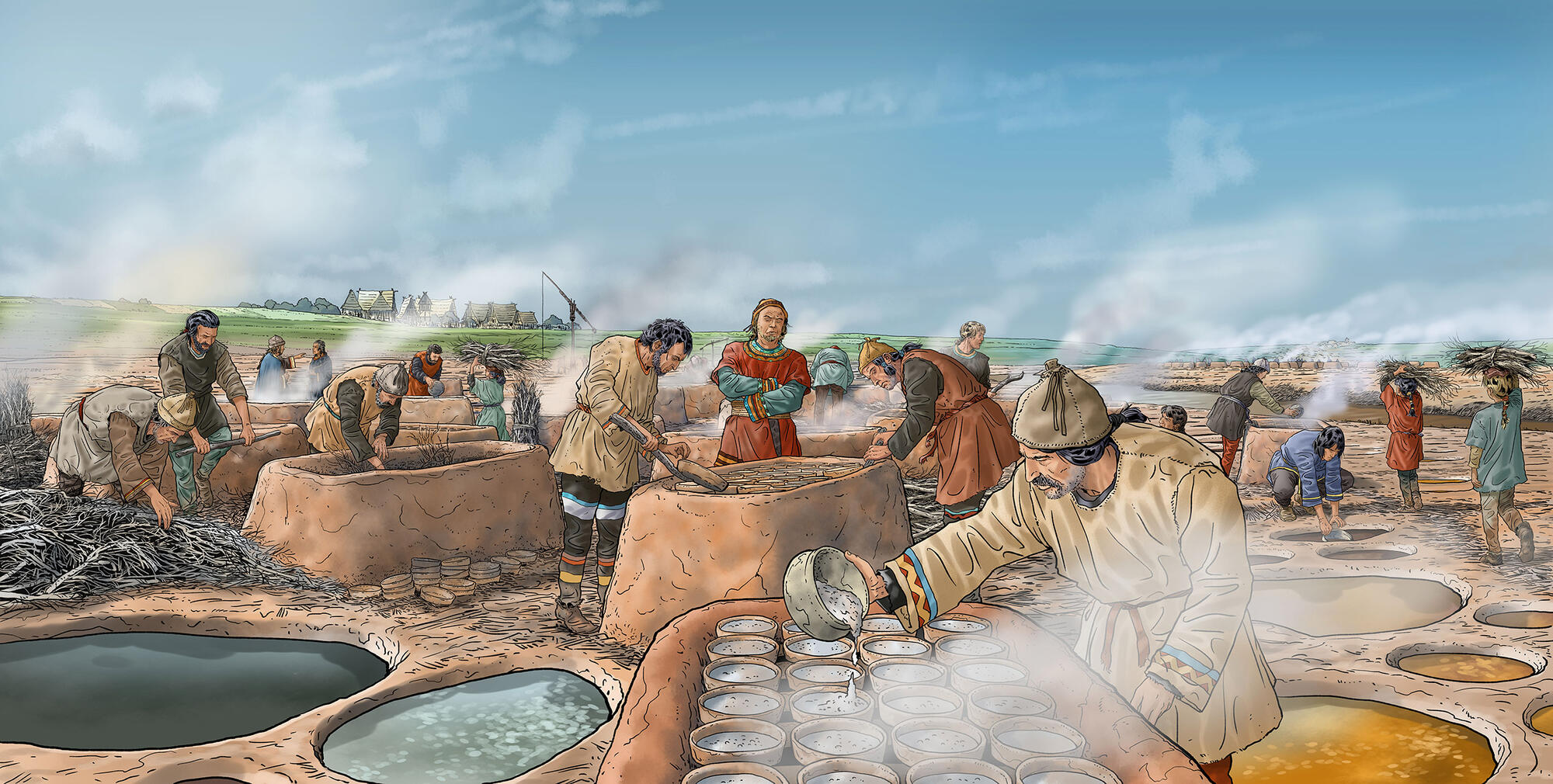
The Channel coast workshops
A series of Iron Age salt production workshops has been documented on the Channel coast, mainly between Boulogne and Abbeville. At the various sites excavated, "pillar" furnaces were used until the beginning of the 3rd century BC., giving way to furnaces with grates, which have been shown to have been used from the second half of the 3rd century BC, such as at Sorrus (Pas-de-Calais). The grate furnaces were found set up in oblong pits, generally running from north-west to south-east. These constructions could be very substantial in size, such as at "La Bruyère" in Sorrus (length = 4.22 m, width = 1.20 m) or in Pont-Rémy (Somme; length = 5.52 m, width = 1.72 m). These structures date from the late Gallic period (2nd–1st centuries BC) It was during the Augustan period that grate furnaces seemed to reach their maximum dimensions, as can be seen at the "Le Fond de la Commanderie” site in Conchil-le-Temple (Pas-de-Calais; length = 7 m, width = 3.10 m).
Generally speaking, the transition from "pillar" furnaces to "grate" furnaces was accompanied by a corresponding change in the vessels used to hold the brine, which evolved from short truncated cone shapes, for which there is evidence of their use in the 6th–5th centuries BC (such as at "Le Bois Vieil" in Vignacourt, Somme) to tall cylindrical vessels. The latter predominated during the late Gallic period and became widespread from around the 3rd century BC. During the Augustan period, saltworkers used large, tall cylindrical vessels made up of three vertical pieces (Conchil-le-Temple).
This Gallic salt-making equipment was discovered within settlements delimited by large ditched enclosures. At "La Bruyère" in Sorrus, a small oval-shaped enclosure contains a grate furnace flanked by a brine tank. The complex is linked to a cased well (potentially a brine well) located right next to the enclosure. A series of wooden artefacts that are pieces of equipment used by saltworkers in the late Gallic period have been uncovered at the Sorrus site. Of particular note are the hemicircular plates with a hole for a handle to pass through, which appear to have formed part of the paddles used to scrape the brine.
The Normandy coast workshops
Evidence of a series of small workshops, active between the 6th and 1st centuries BC, has been found along the coast of the Channel, mainly between the Bay of Mont-Saint-Michel and the mouth of the Seine. The evolution of production methods is characterised by the succession of two main types of salt furnace. In the 6th–4th centuries BC, pillar furnaces were used. These were equipped with pedestal-type supporting pieces, which were often forked at the end. The rest of the technical components were mainly made up of shaped balls used to hold everything in place. From the 3rd century BC, furnaces began to evolve into the "grate" type. These types of facilities, which were used until the beginning of the Early Roman Empire, were used with tall cylindrical vessels. These vessels evolved into truncated cone shapes during the 1st century AD.
The Armorican coast workshops
There is evidence of a series of small production units on the northern coast of Armorica, most of which date from the recent Gallic period. These facilities, which were probably family-run, generally combined a furnace and several brine tanks (Les Ébihens, Pleumeur-Bodou; Côtes-d'Armor).
Another series of salt distillers' workshops were spread along the southern coasts of Armorica, particularly around the Gulf of Morbihan. Pillar-type furnaces have been found at sites dated to the 6th–5th centuries BC, as seen at the workshop on the Guérande peninsula (Loire-Atlantique). "Grate" furnaces, equipped with arch and strut components, became widespread during the subsequent Late Gaulish period (2nd–1st centuries BC). These fixed-grate structures were used with very thin-walled vessels in the shape of truncated prism-shaped containers (troughs).
Workshops on the Gironde coast
In the Pays-de-Retz, south of the mouth of the Loire, as seen at the workshops along the coast from the Channel to Armorica, there was a change in production methods, with "grate"-type brine furnaces replacing the traditional "pillar" furnaces. This change appears to have taken place at the end of the 4th century or during the 3rd century BC, during the transition into the Late Gaulish period. The pillar furnaces were used with cylindrical, truncated-cone-shaped brine vessels. The grate furnaces discovered have rectangular, excavated heating chambers that are around 2.50 m long. The grates, assembled using arch and strut components, were used with thin-walled, truncated prism-shaped troughs.