
Preliminary surveys
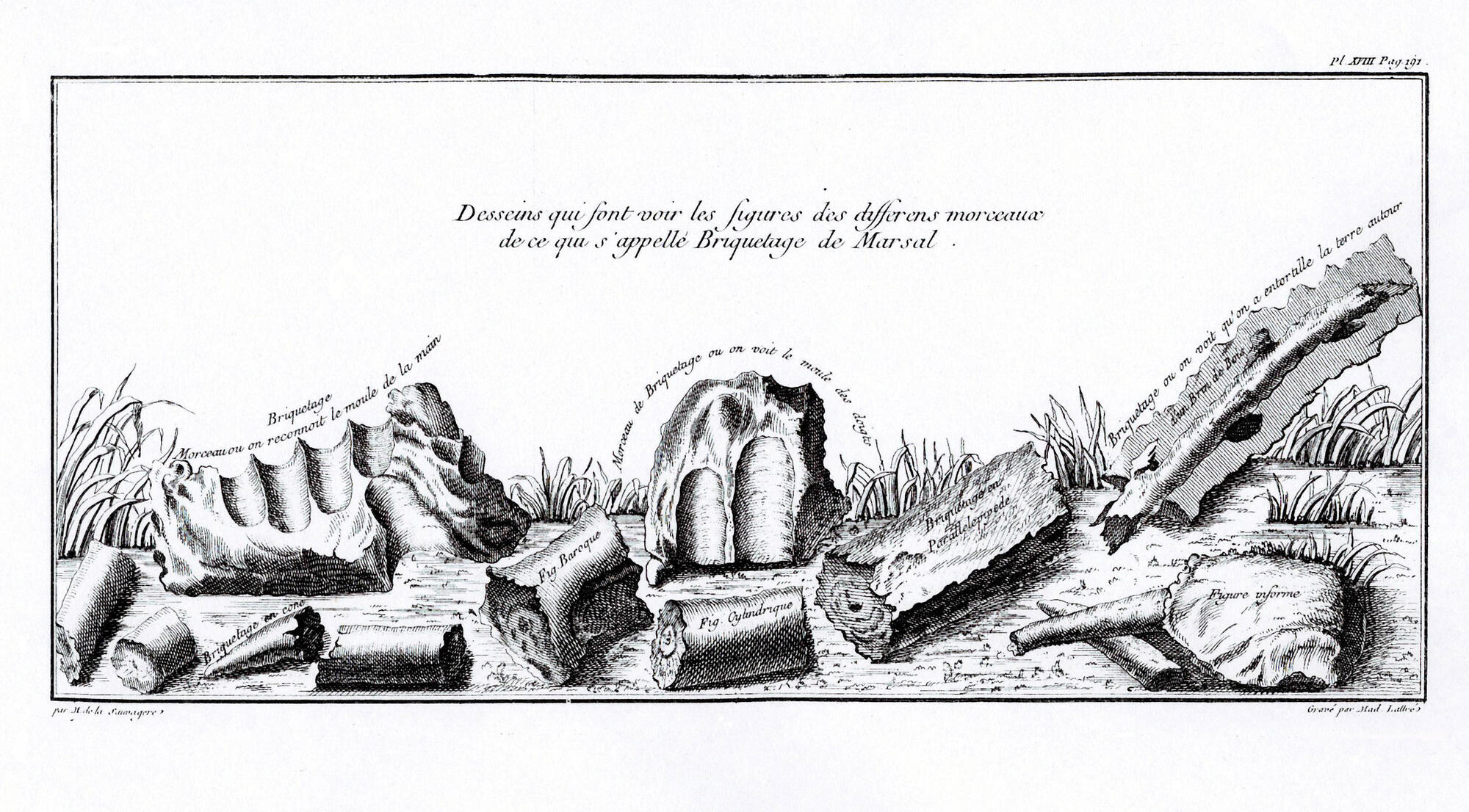
In 2001, the Lorraine Regional Archaeology Department commissioned Laurent Olivier, curator at the National Archaeology Museum in Saint-Germain-en-Laye, to carry out a research programme with the aim of compiling a summary of what was known about the "Briquetage de la Seille".
Conducted between 2001 and 2005, the first phase of the Briquetage de la Seille project aimed firstly to identify the geographical extent and internal organisation of the production sites, evidence of which could be found in the accumulations of briquetage known to have existed since the 18th century. In addition, the aim of these field surveys was to provide information for studying the long-term impact of intensive salt mining, both on the natural environment and on the human societies of the first millennium BC.
The fieldwork consisted mainly of extensive geophysical surveys of the briquetage workshop areas, covering a total area of almost 80 hectares. This reconnaissance work was combined with test digs to validate the geophysical anomalies detected, and to clarify their nature and, where appropriate, their chronology. These one-off excavations resulted a series of laboratory analyses, focusing on dating (radiocarbon, archaeomagnetic and thermoluminescent) and reconstruction of the palaeoenvironmental environment (anthracology, archaeobotany, malacology, palynology).
Excavation of the La Digue workshop area in Marsal
In a second phase, field research focused on reconstructing the links in the salt production chain, thanks to the excavation of a workshop area dating from the 6th century BC identified at Marsal ("la Digue"). It was shown that a salt extraction model other than the one that had been traditionally accepted had to be considered: the salt blocks were not produced by evaporating the brine in the salt moulds, which would have meant wasting considerable quantities of fuel. The salt crystals were first extracted from the brine, which was heated in flat-bottomed terracotta "basins" and then the resulting salt was combined in porous clay "salt moulds" made using templates. The moulds were then broken apart to release salt blocks of standard volumes and weights.
Excavation of the Pransieu workshop in Marsal
In a third and final phase of work, carried out between 2014 and 2017, research focused on the extensive surveying of a small workshop from the Early Iron Age, identified through geophysical prospecting in Marsal ("Pransieu"). The aim was to determine the range of different structures associated with the salt production chain and their distribution within a coherent production unit.
This made it possible to demonstrate that mass production had taken place, enabling brine to be heated simultaneously in several furnaces that were probably fed continuously. Brine tanks were used to supply the facilities with salt water that had been pre-treated in the surrounding area. Some workshops, such as the one explored at "Pransieu A2", only produced salt in crystals, while in other areas of the Marsal production complex, neighbouring workshops supplied salt made into standardised blocks.
First glimpses of the Gallic and Roman saltworks
The latest excavation campaign in 2017 revealed the last evidence of activity from the late Gallic period, which lasted until the early 1st century AD. These are followed by large parallel pits belonging to craft or industrial facilities dating from the Roman period, which were in operation until the beginning of the 4th century.
Associated media
Open Media Library

Prospection géomagnétique au sol

Examen d’une carotte de sédiment

Vue aérienne de la fouille du site d’atelier de sauniers de La Digue

La fouille du site d’atelier de sauniers du Pransieu A2 à Marsal

Fragment de céramique sigillée
