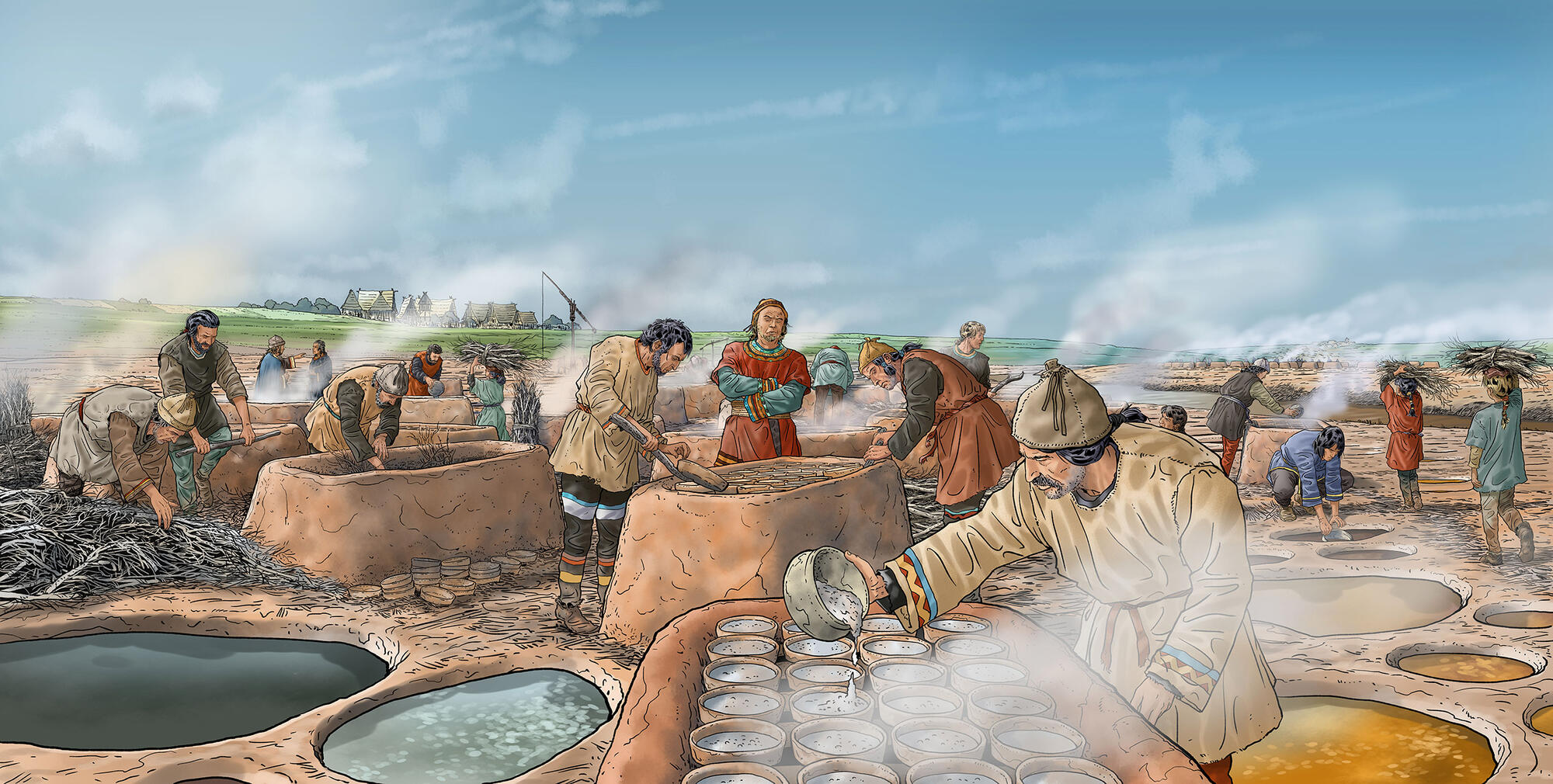

The Celtic miners of Hallstatt (Austria)
At Hallstatt, in the Salzkammergut region, a large rock salt bed was mined. Mining began as early as the Bronze Age, between the 14th and 10th centuries BC, before reaching a peak between the 8th and 4th centuries BC, during the Early Iron Age. It is estimated that the Hallstatt mines produced a volume of 54,000 m3 during the Iron Age period, i.e. almost double that of the Bronze Age.
The mine shafts were dug from the side of the mountain, where they sank to a depth of more than 200 m. They have yielded a wealth of remains left behind by the miners, miraculously preserved by the salty environment: bronze-tipped picks, leather sacks used to extract the salt blocks, caps or berets worn by the miners, and countless remains of the wooden torches used to light the mine shafts.
Major mudslides appear to have brought mining to a halt in the 6th century BC.
The salt miners' cemetery
A vast necropolis, which must have contained 5,000 graves, has been discovered in the vicinity of the mine entrances. Only a quarter of them were able to be excavated. These graves concealed exceptional artefacts, thanks to which the Hallstatt site gave its name to the European civilisation of the Early Iron Age. Artefacts from far-off places were discovered in the graves, serving as evidence of the long-distance trade in which the salt miners participated: drinking vessels, weapons and ornaments from Northern Italy and Slovenia, amber from the Baltic Sea, elephant ivory imported from Africa...
Analysis of the human bones reveals numerous marks linked to their work, indicating that the people buried in the necropolis were indeed those who extracted salt from the nearby mines. The men worked deep down in the mine, cutting the salt with picks, while the women were assigned to carrying and transporting the extracted blocks to the surface. Children were also employed to carry out secondary tasks. It is estimated that a community of several hundred people (300 to 500) worked the mines at Hallstatt during the Early Iron Age.
The mining community of Hallein (Austria)
The Dürrnberg salt mine at Hallein is located around fifty kilometres from Hallstatt and appears to have developed following the decline of its predecessor. Mining began in the 6th century BC and reached its peak around the 3rd century BC. It was then rapidly abandoned in the course of the 2nd century BC. As at Hallstatt, numerous tools and pieces of equipment used by the protohistoric miners have been uncovered in the mine shafts.
The site of the Dürrnberg mine is directly linked to a vast necropolis, used between the 6th and 1st centuries BC. The tombs excavated there contained numerous luxury objects, evidence of long-distance trade. In particular, a collection of pieces considered to be some of the masterpieces of early Celtic art were uncovered at the Dürrnberg necropolis.

