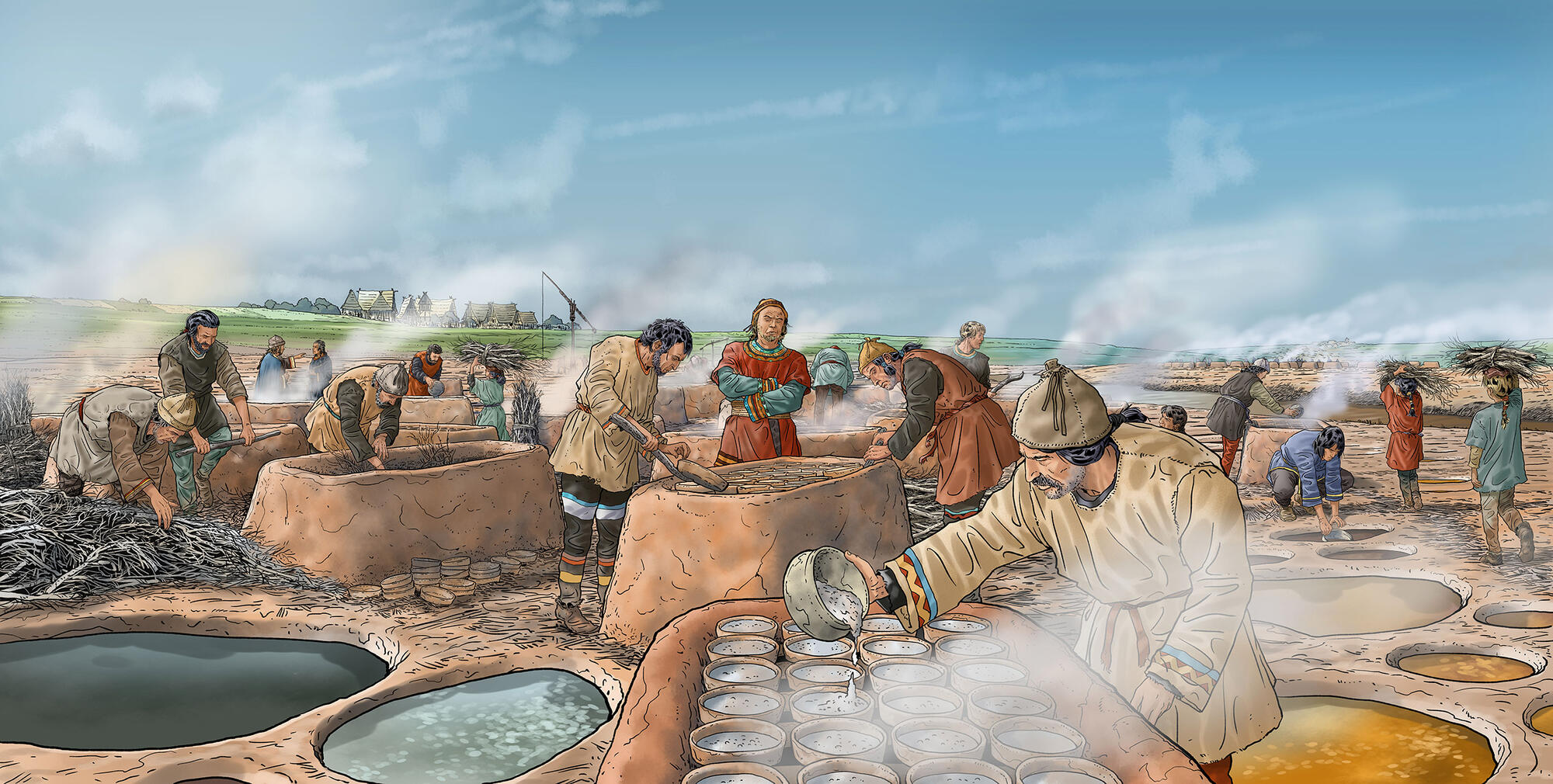
The Halle saltworks (Germany)
The briquetage at Halle (Saxony), in the Saale valley, is one of the most important protohistoric salt production sites in continental Europe, after the one in the Seille valley. The remains of 25 piles of accumulated briquetage, spread over an area of some 4 kilometres in length, have been identified beneath the site of the current town.
Briquetage at Halle mainly dates from a period extending from the beginning of the 7th to the 3rd century BC. The furnaces are of the "pillar" type and use pedestal-type supports. Salt mining ceased at the end of the Gallic period and continued until the Slavic migrations of the early Middle Ages.
The Bad Nauheim saltworks (Germany)
The briquetage at Bad Nauheim (Hesse), near Wiesbaden, consists of two large deposits, each 400 to 500 m long (known as the Saline Nord and Saline Sud), which are located partly beneath the present-day town. The accumulated briquetage can be as much as 5 m deep in places. The low salinity of the local brine must have been increased artificially: recent research has revealed a vast complex of square basins with stone-lined bottoms, linked by a system of wooden channels, which were clearly used to concentrate the brine.
Salt mining at Bad Nauheim dates from the 5th to the 1st centuries BC. The furnaces used are of the "pillar" type and are associated with small vessels with curved truncated cone-shaped sides (5th–4th centuries BC), which evolved into less truncated cone-shaped or even spherical forms during the 2nd–1st centuries BC. Salt production at Bad Nauheim clearly facilitated the emergence of a privileged social class, as demonstrated by the Glauberg burial mound, located around 20 kilometres from the Iron Age saltworks.
The saltworks at Schwäbisch Hall (Germany)
Like Bad Nauheim, the Schwäbisch Hall site (Baden-Württemberg) dates mainly from the 5th to the 1st centuries BC. The salt furnaces, probably of the "pillar" type, used small vessels with a curved truncated cone-shaped body and a thick, inward-turning lip, which have been dated to the 3rd–1st centuries BC. Excavations revealed large wooden structures used to collect, channel and probably concentrate the brine. In particular, a system of pipes was uncovered, as well as a cased well from which the brine must have been drawn.
Droitwich saltworks (Great Britain)
In the Cheshire and Worcestershire region of western England, salt springs were exploited during the Iron Age. In Droitwich, as in Cheshire, there are known areas of accumulated briquetage, the production of which is dated to the 6th–5th centuries BC, at the beginning of the Roman period. The brine vessels are characterised by their tall, cylindrical, slightly truncated cone-shaped body with an outward-facing opening.