
The revelations of the century of Louis XIV
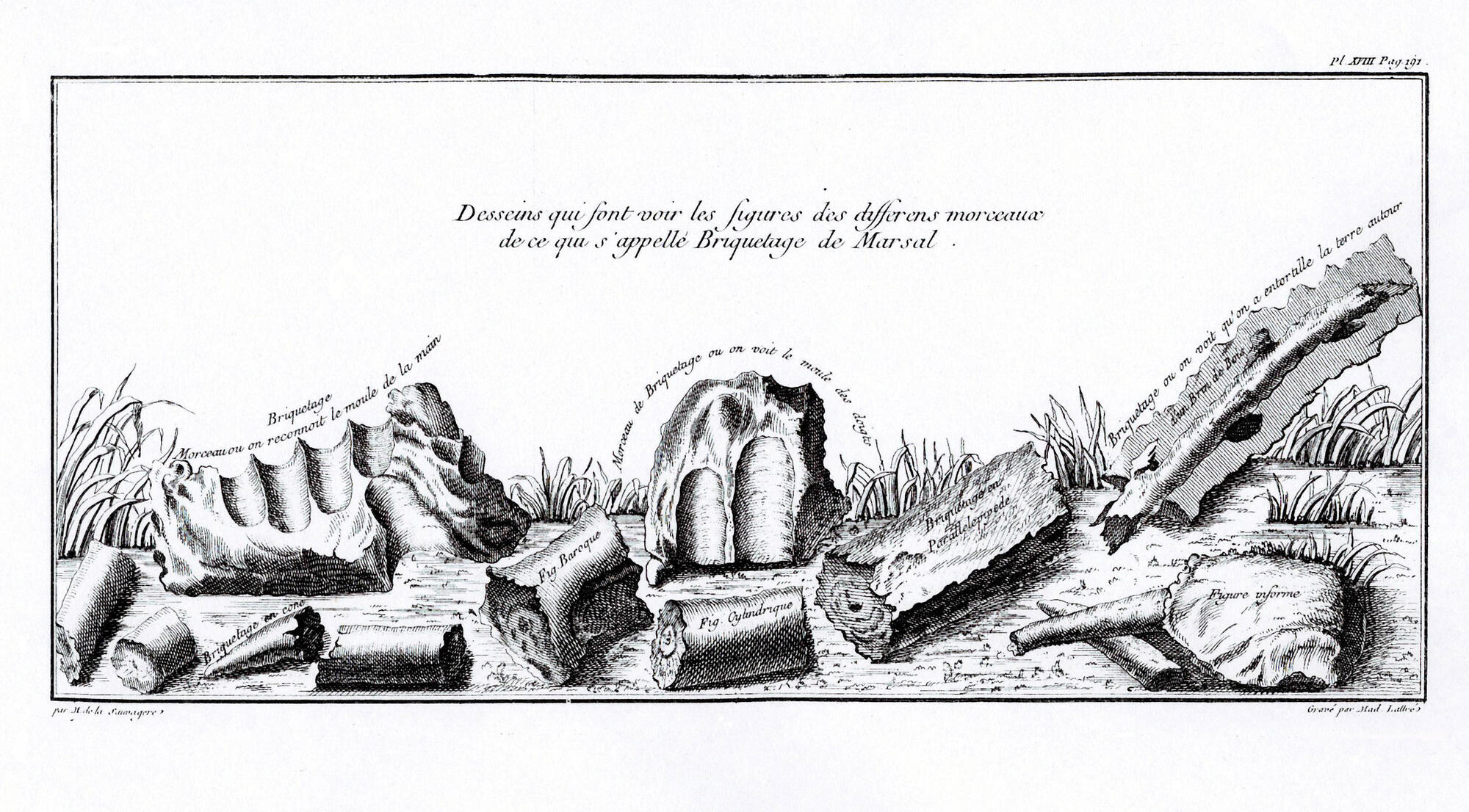
Since medieval and modern times, the Seille valley has been a strategic region, fought over by the Church and the nobility, then by the Duchy of Lorraine and the Kingdom of France. In modern times, this part of Lorraine has been disputed territory, claimed by both France and Germany. Fortification work on Place de Marsal at the end of the 17th century, during the reign of Louis XIV, uncovered a vast accumulation of terracotta fragments on which the town was built. This is known as briquetage. The royal engineer Félix Le Royer de La Sauvagère (1707–1782) carried out the first excavations to determine its origin.
Based on its imposing size, the "Briquetage de Marsal" is considered to be the work of the Romans. Other deposits of terracotta debris were identified in Moyenvic, as well as at the Burthecourt estate in Salonnes (Moselle).
The German excavations by Johann-Baptist Keune (1901)
For most of the 19th century, the reason for this prodigious work remained a mystery. The "Briquetage de la Seille" is sometimes attributed to the Franks, the Gauls, or even the populations of the "Age of Reindeer".
After the annexation of Alsace-Moselle, large-scale excavations were carried out in 1901 by the curator of the Metz Museum, Johann-Baptist Keune (1858–1937). This initial systematic research has enabled us to attribute these remains to a salt industry, which extracted the salt from the brine of salt springs, dating from the Iron Age.
In the rest of Europe, such as Germany, Belgium and Great Britain, archaeologists discovered formations of terracotta debris similar to those in the Seille valley. The term "briquetage" was coined by the international scientific community to describe these accumulations of salt production waste resulting from the heating of brine and the subsequent production of salt blocks in earthen furnaces and moulds.
The ghost museum of Armand Demange (1890–1940)
A farmer in Marsal, Armand Demange (1872–1948) undertook field research into briquetage in Marsal and set up a local museum in the years leading up to the First World War. Located on the first floor of one of the Vauban barracks, this "museum of briquetage" housed thousands of archaeological finds, which disappeared during the German annexation of the Second World War.
Jean-Paul Bertaux's research (1969–1980)
In the 1970s, Jean-Paul Bertaux, an engineer with the Lorraine Regional Archaeology Department, undertook a series of surveys. This work has made it possible to draw up an initial general map of the accumulations of briquetage in the valley, as well as carry out an initial identification of the different types of technical terracotta components used to produce salt.
Associated media
Open Media Library

« Desseins (sic) qui font voir les figures des differens (sic) morceaux de ce qui s’appelle Briquetage de Marsal »

Les fouilles de Johann Baptist Keune

Fragments de céramique domestique

Armand Demange présentant sa collection de fragments de briquetage

Topographie des « îlots » de briquetage reconnus dans le secteur de Marsal

Vue du sondage réalisé en 1974
