
The "have-nots" of Marsal
In the Gallic period, salt-making communities exploited a dependent workforce of lower social status. At the "la Digue” site in Marsal, the bodies of seven adults and one child aged between 4 and 6 years old were discovered in an abandoned grain silo. They have been radiocarbon dated to around the middle of the 4th century BC. Strontium analysis indicates that these people were of local origin, while their DNA shows that they were not related to each other.
These individuals suffered repeated trauma, with fractured hands in the case of the men and fractured ribs in the case of the women. Most of them suffered from pathological deformities of the soles of their feet, associated in particular with carrying heavy loads. The fact that a small child (whose DNA unfortunately could not be studied) was among them suggests that this particular social status was undoubtedly hereditary.
Bodies thrown away with the rubbish?
Incomplete human remains are mixed in with the waste from domestic activities associated with the salt-making workshops. Several fragments of adult skulls were found at the "Fort d’Orléans" workshop area in Marsal, which was occupied in the 6th century BC. The incomplete remains of several individuals, both young and adult, have been found scattered around the site of the "Pransieu A2" workshop in Marsal, also dating back to the 6th century. Among them was a child aged between 6 and 9 years old. Some of these bones show the bite marks of carnivorous animals, which devoured the flesh and gnawed on the bones near the joints.
Excavation of the "la Digue" workshop area in Marsal also yielded two fragments of human femurs used as lissoirs. These pieces were probably collected from the rubbish, as they had been chewed on by carnivores.
The world of the privileged dead
A vast burial area, used throughout the Iron Age, has been identified in the vicinity of the "Pransieu" workshop complex, this being the "Bensale"’ and "les Grands Pré" sites in Marsal. Here there are burials of people of high social standing, interred between the end of the 6th century and the beginning of the 5th century BC. These tombs must have belonged to the population of Celtic and Gallic saltworkers who ran the salt production workshops.
Upstream from Marsal, a necropolis of burial mounds located in Mulcey (Moselle) know as "les Pâquis" revealed the presence of a large mound some fifty metres in diameter today, with the main grave located in a large burial chamber measuring 4 to 6 metres on each side. This type of monumental structure may have housed a chariot tomb from the end of the Early Iron Age, contemporary with the Celtic salt-making workshops in Marsal.
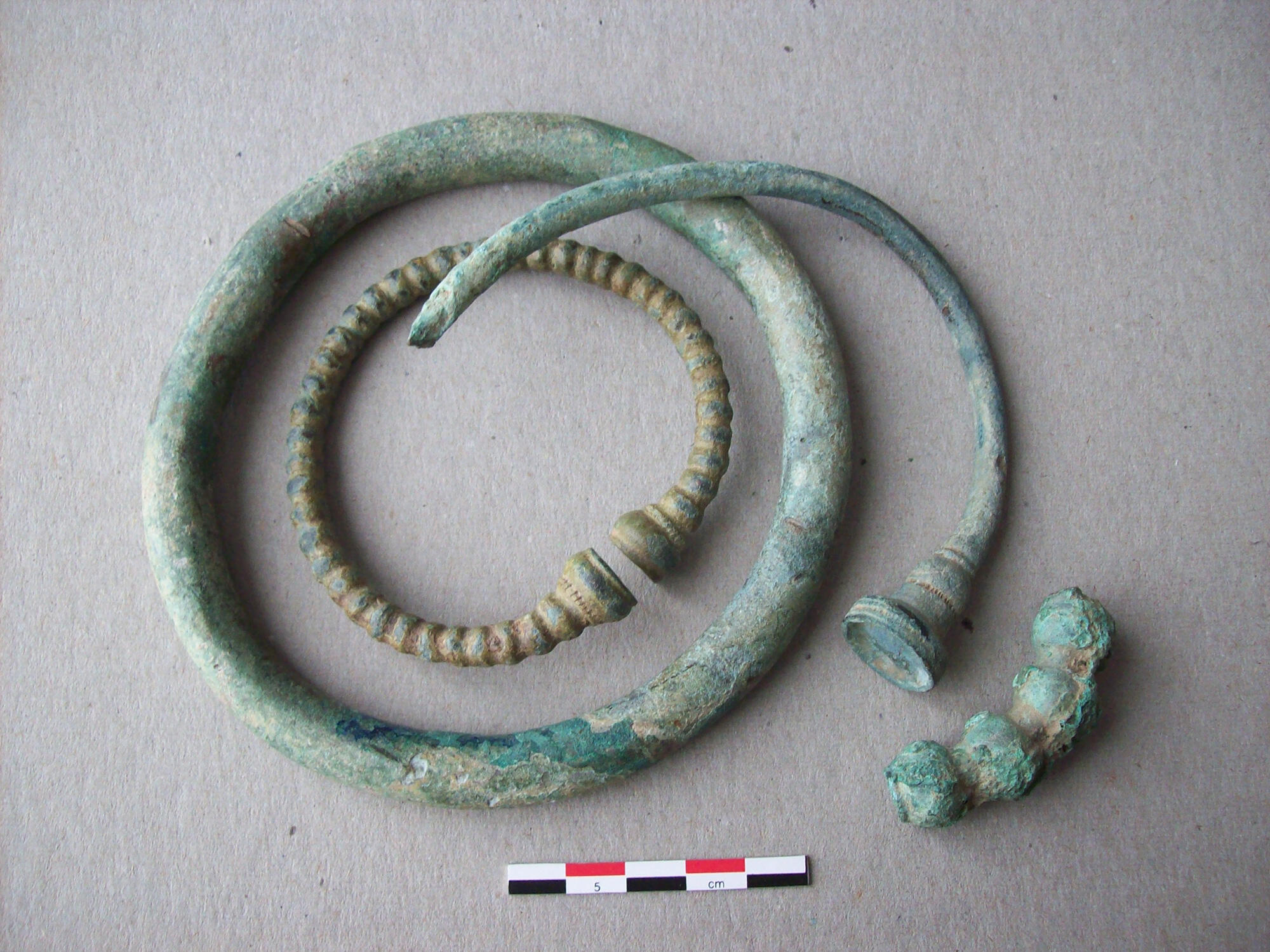
In Moyenvic, the large mound of "la Motte" must also form part of a monumental burial mound, around which agricultural work has unearthed bronze bracelets and leg rings dating from the 6th to the 4th centuries BC.
In the surrounding area, ancient finds point to the presence of groups of burials of people of privileged status dating mainly from the 4th century BC. One of these was found in Marsal in 1838, during work to rectify the course of the Vieille Seille. Another, "la Croix Rayeux", was discovered during agricultural work undertaken in Moyenvic in 1880.
Changes in Gaulish society
The last evidence of imports of precious items — such as amber, gold and coral — dates from the 4th century BC. Luxury goods from faraway places were absent during the recent phase of the Briquetage de la Seille, spanning the 2nd and 1st centuries BC. We can probably deduce from this that the communities of saltworkers ceased to grow rich through their work, even though their production capacities were multiplied.
From then on, salt extraction was probably controlled by aristocracies established on the outskirts of the valley. Some of them may have occupied large agricultural estates nearby. It is even possible that the production of salt from the Seille came under the authority of the Mediomatrici people, whose capital was Metz.


