

The Grand zodiac tablets
Since the 18th century, the village of Grand has attracted the interest of archaeologists, who have revealed the immense scale of certain monuments, in particular its amphitheatre, one of the largest in Gaul. The aim of current research is to gain a better understanding of the ancient settlement that produced these exceptional tablets.
A city of highly original buildings
The basilica and its mosaic
Discovered in 1883, this basilica houses a mosaic measuring 232 m2, one of the largest preserved mosaics in France. The central part of the floor covering is distinguished by its rich geometric decoration and the presence of two felines, a bear and a wild boar. These animals frame the partially preserved emblema, in which two characters evoking a Greek comedy by the poet Meander can nevertheless still be seen. This building was probably one of the most imposing structures to stand at the centre of the ancient city. Its apsidal design, very common in Antiquity, suggests a variety of functions, all of which are merely hypothesis: a meeting place for the local administration (court), a temple or even a reception hall for the headquarters of a guild (schola).
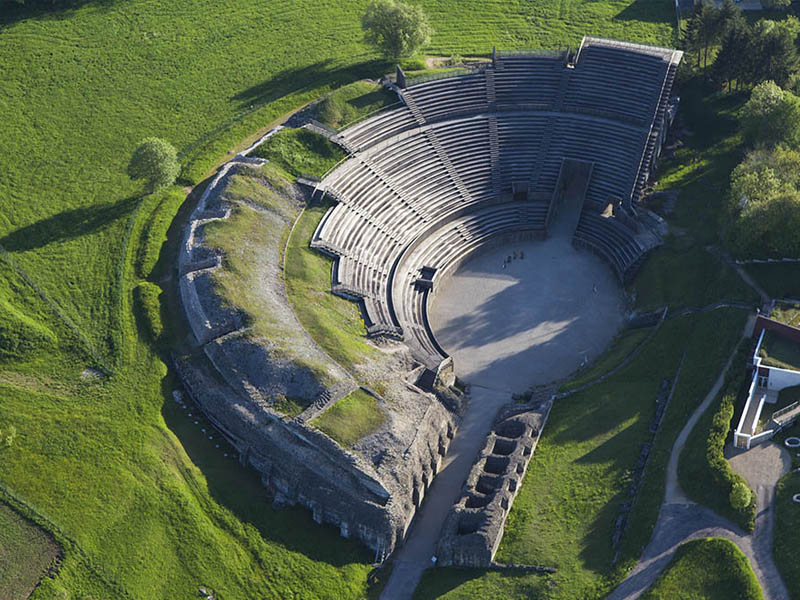
An amphitheatre to the east of the town
Although it was not considered a capital city, Grand – whose ancient name is unknown — had an amphitheatre of 148 m in length, which could hold between 16,000 and 17,000 spectators. Set in a valley, it stands out due to its unique layout: the southern part backs onto the slope, while a monumental façade stands to the north.
The two arcades that can be seen belonged to the façade of the monument. This part of the amphitheatre is characterised by the use of large stone blocks, probably the result of a renovation phase. To protect this particularly fragile limestone, a wooden roof was installed in 1995. This architecture restores some of the original features (corridor vaults, staircases, stands), thereby restoring some of the building's volume.
A rampart of unknown age
Still partially standing in the 18th century, the Grand enclosure covers almost twenty hectares and is tangential to the concentric path mentioned above, lying to the west. Covering a total area of around 17 hectares, this rampart protected the valley in which the spring was located, as well as a number of public buildings, including a vast basilica-shaped building.
These fortifications were equipped with several gates and numerous circular towers ranging from 6 to 10 m in diameter. With a few exceptions, the fortifications were built in northern Gaul in the 3rd and 4th centuries, during the period of insecurity that prevailed in this part of the Roman Empire. The quality and technical characteristics of the Grand rampart soon led archaeologists to suggest that it was built at the end of the Ist century, during the Pax Romana.
The zodiac tablets: an exceptional discovery
It was during the excavation of one of the village's many wells in 1967 that around ten fragments of ivory tablets were unearthed at a depth of almost 8 m. In July 1968, the bottom of the well was excavated in difficult conditions, but the archaeologists managed to collect 188 fragments, which turned out to be two richly decorated ivory diptychs.
Ivory diptychs at the bottom of a well
The ancient town of Grand is unusual in that it is located on a limestone plateau with no watercourses. This unique characteristic explains the existence of numerous wells and cisterns which, since the 19th century, have yielded numerous sculptures and statuettes, as well as a wide range of exceptionally unique objects such as astrological tablets. It was during a land consolidation operation that Chantal and Jean-Paul Bertaux unearthed fragments of two ivory diptychs in a well in the south of the town. The brown colour is due to prolonged exposure to water.
These tablets, intentionally broken and thrown into the well, were part of a collection of various different objects dating from the end of the 2nd century, which are thought to have been domestic waste: ceramics, ornaments, hairpins and fauna. Analysis of these objects revealed the presence of around thirty animals, including wild species (wild boar, deer, birds) and domestic species (pigs, dogs, cattle, etc.).
Rich engraved decoration enhanced by colour
The study carried out by Jean-Yves Béal showed that the ivory, taken from a large elephant tusk, had been engraved with a chisel and a gouge. While some of the figures still show traces of pigment and gilding, it is also possible that some parts, particularly the stars around the edge, were coated with paint, as suggested by the presence of hollowed-out areas. A study currently underway at the Centre de Restauration des Musées de France should provide new information on this polychromy. We can therefore imagine that these tablets must have looked very different, with the light shade of the ivory and colourful highlights. There is no way to identify the exact range of colours used, but it is possible that they were symbolic, reflecting the content of the tablets.
A celestial and zodiac chart
At the centre of each of the diptychs are Sol and Luna, identifiable by their attributes: a radiating headdress and whip for the Sun (Helios or Apollo), and a crescent for the Moon (Selene or Phoebe). The twelve signs of the Zodiac that surround them, based on an Egyptian model, are surmounted by the five letters of the Greek alphabet signifying the domain of the planets in each of them. The Egyptian figures in the third ring are grouped in threes, in relation to the decans. These figures form a reference set for astrological representations, alongside Bianchini's planisphere, which was discovered in Rome. The names of the decans are shown above, in ancient Coptic. Finally, the winged creatures that can be seen in the corners can be interpreted as representing the Winds that move the Universe, symbolised here by the stars.
A medium for divination
This celestial and zodiac chart is the product of a learned Hermetic tradition that probably originated in the Greco-Egyptian world, and should be viewed in relation to other similar depictions, notably those from Dush (Kharga oasis), whose size and therefore portable nature are comparable to those of the Grand model. In contrast to the size of the depictions of the zodiac in certain Egyptian temples — notably the ceiling of Dendera temple in the Louvre — these tablets were objects that had to travel and were only to be opened for the very limited purpose of astrological consultation. Inaccessible to the layman, these tablets were used to draw up horoscopes and medical astrology, but could also be used to practise magic, these two approaches being complementary in Antiquity.