

The Roucadour cave
Closed to the general public for conservation reasons, Roucadour is a lesser-known cave. It is one of the oldest decorated caves in Quercy (Pech-Merle, Cougnac, Les Merveilles, Marcenac, Les Fieux), whose cave art is attributed to the Gravettian culture (between 33,500 and 27,000 BP).

Discovery and studies
The decorated gallery is part of a wider karstic network that has been known about since the end of the 19th century. It was discovered in 1962 by two members of the Brive Speleological Club, Jean-Paul Coussy and Pierre Taurisson. The study of the cave was entrusted to Father André Glory in 1964. André Glory, who had just been recruited as an engineer at the CNRS and was responsible for studying and surveying the art in the Lascaux cave, which was closed in 1963, carried out five survey missions between 1964 and 1966. Sadly, he died in a car accident on 29 July 1966, along with his close collaborator Father Jean-Louis Villeveygoux.
Research into the art of Roucadour came to an abrupt halt and did not recommence for another thirty years or so, starting up again in 2002 with the involvement of Michel Lorblanchet, Research Director at the CNRS. Working in collaboration with Jean-Marie Le Tensorer, then Professor of Prehistory at the University of Basel, he led a multidisciplinary international team for seven years — the time needed to complete the studies and produce new surveys of the decorated gallery. An initial publication comparing A. Glory's records with those of the new team was released in 2009. A complete monograph on the art of Roucadour has been available since 2022 in a supplement to the journal Préhistoire du Sud-Ouest.
An original bestiary and outstanding aesthetic quality
Most of the cave motifs, of which there are 495, are to be found inside a joint in the rock at the end of the decorated gallery. There are 140 engraved animal figures, mainly horses, felines, Megaloceros and, in smaller numbers, bison, mammoths, ibex, deer and a few aurochs.

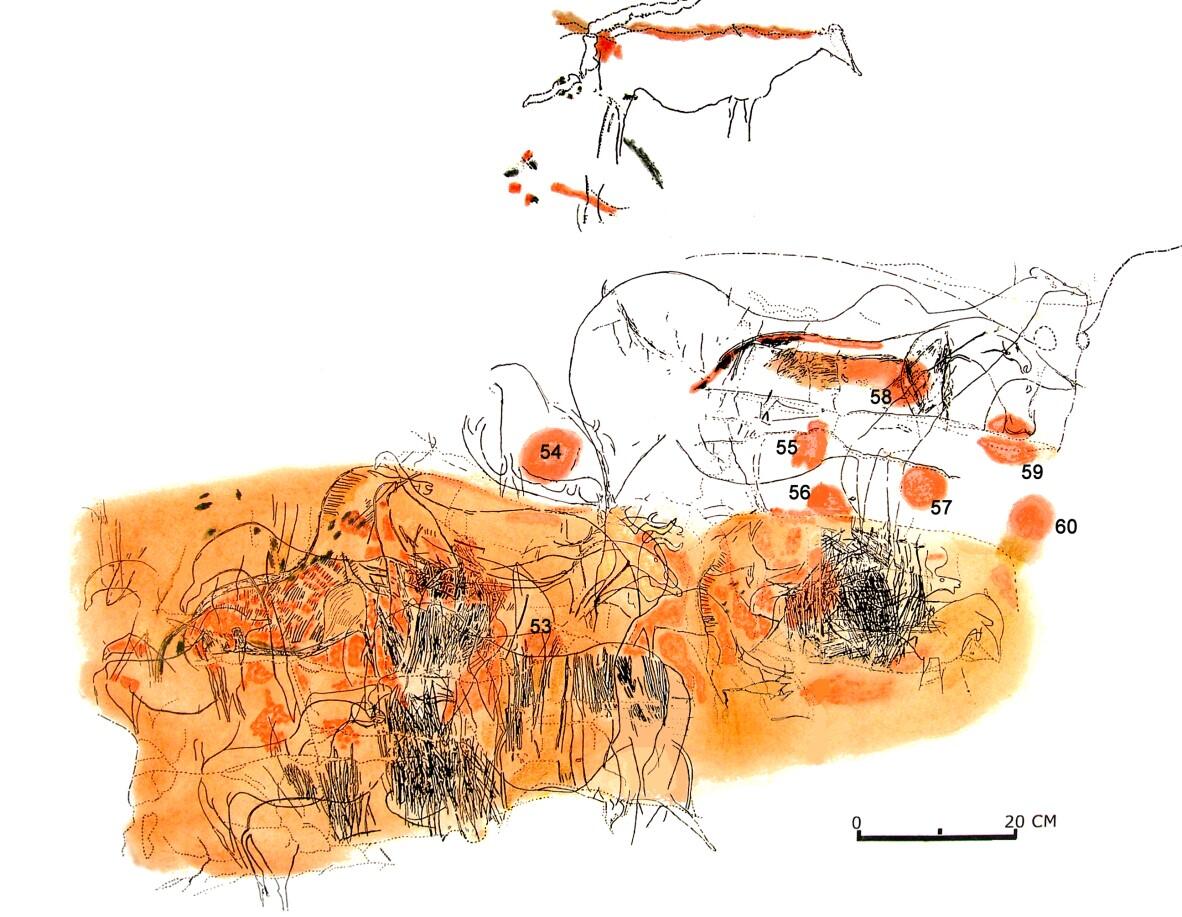
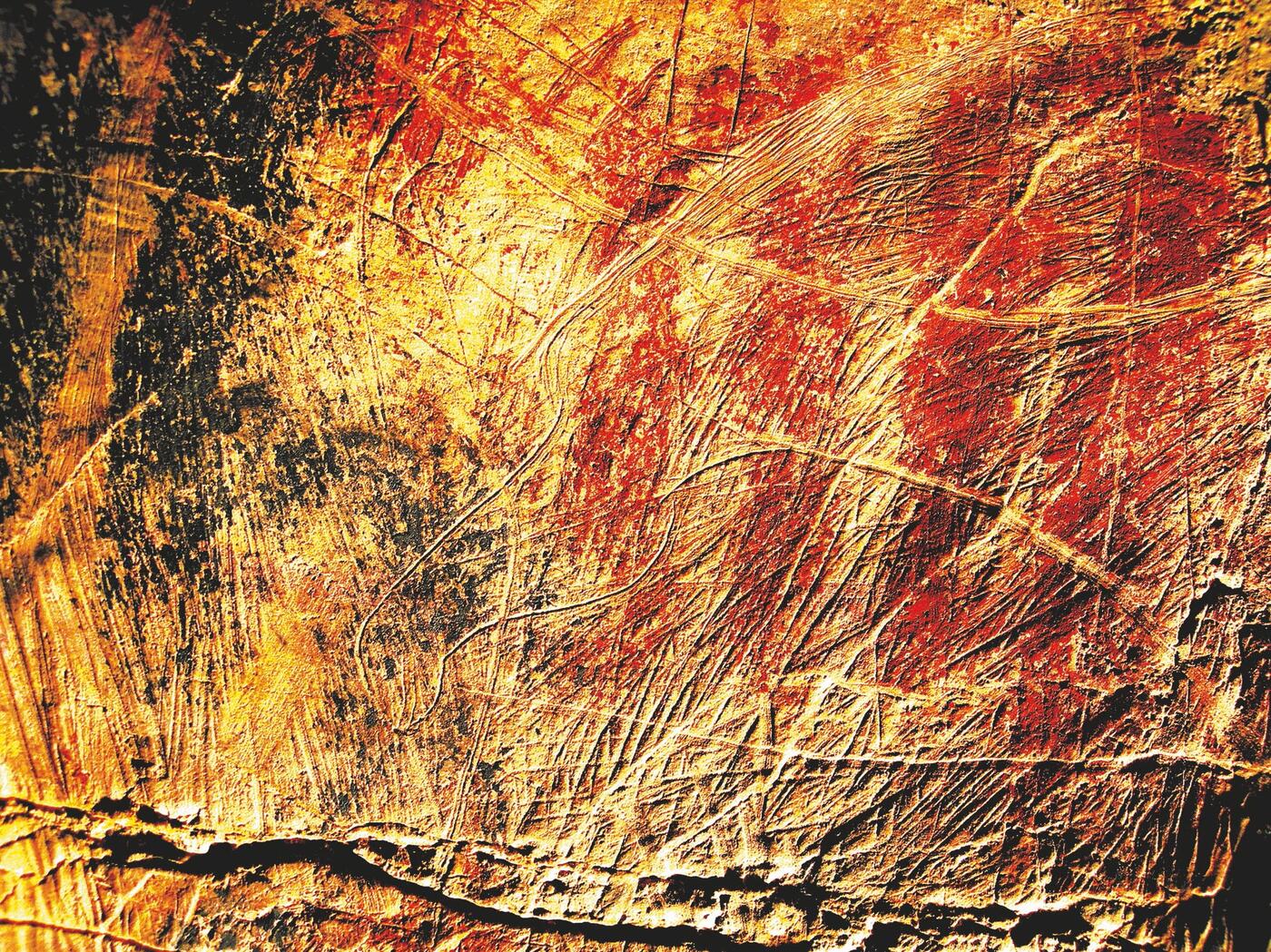

Palaeolithic artists were not preoccupied with respecting the animals' anatomical proportions. The horses' heads are often small and elongated, in the shape of a "duck's beak" (to use H. Breuil's expression). The legs are sometimes stylised, sometimes simplified into an X or Y shape, and are often exaggeratedly short, sometimes exaggeratedly long. Bison are depicted as huge animals with deeply arched backs and rounded bellies. Some of the horns are lyre-shaped and seen from the front. Mammoths have a very high ventral line and long legs. In a few examples of figures, we can observe the paradoxical anatomical precision of certain details: weeping eyes, the gland on the neck of the Megaloceros, mammoths' anal operculum, or the unexpected accuracy of a hoof or mane.
The animals are accompanied by geometric depictions (symbols) and painted and engraved hands. The feminine symbolism evoked by the two decorated joints and the limestone micro-reliefs is particularly clear at Roucadour: these natural morphologies seem to have structured the way in which the figures are arranged.

An exceptional Gravettian cave sanctuary
The collection of Roucadour cave art cannot be dated chronologically using C-14 direct dating, because the paintings were produced using mineral pigments that cannot be dated using this method: haematite for the red and manganese oxides for the black. Thematic and stylistic comparisons therefore had to be made with other well-dated, decorated Palaeolithic caves in Europe.
The way in which the figures are superimposed, following one another without any major change in style, suggests that all the cave art here was created during the same period. Its attribution to the Early Gravettian period is based on a number of significant iconographic elements: specific graphic conventions, an animal theme in which lions, Megaloceros and mammoths play a predominant role, the presence of painted and engraved hands and specific symbols (notched circles).
All the formal studies make it clear that the cave art at Roucadour is perfectly mastered, simultaneously conventional, symbolic and full of freedom, sometimes even imbued with fantasy and poetic metaphors.
Partnership
Development of the site was overseen by the Direction des affaires culturelles d'Occitanie, in partnership with the University of Zaragoza's spin-off 3Dscanner "Scanner Patrimonio e Industria".
Learn more
M. Lorblanchet and J.-M. Le Tensorer (ed.) – Roucadour. Une grotte ornée archaïque du Quercy (Thémines-Lot), Villefranche-du-Rouergue, supplement no. 15-2021 to Préhistoire du Sud-Ouest, p. 400