

Megaliths of Morbihan
The construction of megalithic monuments is a phenomenon that has occurred throughout the world at different times. The Neolithic megaliths of southern Morbihan are among the oldest and richest in terms of the number of architectural structures and the prestigious objects and engraved art associated with them.
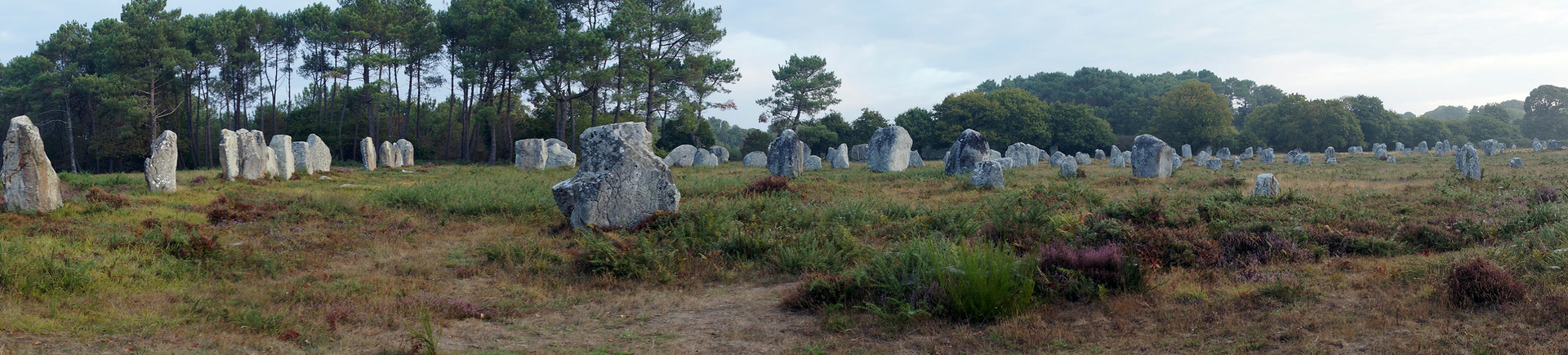
The long process of building a symbolic landscape
These stone and earthen architectures developed and evolved over the course of recent Neolithic prehistory, over a period of more than 2,000 years, between 6,800 and 4,300 years ago. The area around Carnac, the Gulf of Morbihan and Quiberon Bay is home to a huge number of sites (almost 500) and a huge diversity of architecture, from the most ostentatious to the most subtle.
These funerary and/or symbolic buildings are evidence of the desire to leave a lasting mark on the landscape through permanent constructions using stones, some of them very large, at a time when dwellings were still made of perishable materials (earth, wood, cob, thatch, etc.).
Expertise and objects of value serve as evidence of a highly organised society
These monuments are the manifestation of a hierarchical society capable of mobilising its members to carry out elaborate architectural projects. During the earliest periods, megalithic tombs were built for a select few individuals, sometimes accompanied by rare and precious furnishings attesting to their particular social status. Engraved cave art composed of codified and recurring figures and symbols confirms the symbolic significance associated with local megalithism.
A large number of monuments
The aligned standing stones at Carnac, the Table des Marchands dolmen and the Gavrinis cairn are the best-known examples of megaliths in southern Morbihan. They are the bridgeheads of a complex and ramified phenomenon that can only be understood by considering the geographical and physical characteristics specific to this territory and its cultural context.
The importance of the megaliths is such that a good number of monuments have survived to the present day (despite inevitable destruction) and have become an integral part of local life, to the point of becoming emblematic of Brittany.
Where you can see them
The megalithic monuments were not designed to be visited by the public, especially given the high number of visitors to southern Brittany today. Some are tombs with a narrow access, while all are archaeological and natural sites that are much more delicate than they appear. Precautions therefore need to be taken, and certain interior spaces need to be closed off or openings regulated. It is essential that these provisions are respected to ensure the preservation of this architecture dating back thousands of years, so that future generations can continue to enjoy it.
However, a number of monuments and facilities are set up for visitors, allowing them to build up a complete picture of the megalithic phenomenon encountered on the shores of Morbihan:
- Les Alignements de Carnac (a state-owned site managed by the Centre des Monuments Nationaux) and its reception and interpretation building: the Maison des Mégalithes. Part of the site is open to the public in winter, with guided tours and bookings required from April to October. An open-access footpath takes you along virtually the entire 4 km of lines of standing stones.
- The Carnac Museum in the town centre (a Musée de France state museum run by the town of Carnac) displays artefacts excavated from the area's megalithic monuments, as well as local archaeology dating from ancient prehistory to antiquity, with exciting outreach activities for all ages. A new museum will open in 2027.
- The site of the Table des Marchands, Grand Menhir Brisé and Er Grah tumulus megaliths (state-owned property managed by the Centre des Monuments Nationaux) is home to three different major monuments, testifying to the diversity and long history of megalithism. The engravings on the Table des Marchands dolmen are particularly remarkable.
- The Gavrinis cairn (Larmor-Baden, owned by the Département of Morbihan and managed by the Compagnie des Ports du Morbihan) is accessible by boat (booking required). It stands out for the extent of its engraved decorations, which cover almost the entire interior of the dolmen and its access corridor.
- The Petit-Mont cairn (Arzon, owned by the Département of Morbihan and managed by the Compagnie des Ports du Morbihan) is the site of several dolmens and is unusual in that a bunker was built into the megalithic monument during the Second World War.
Many other megaliths are dotted across the region and are freely accessible, at least on the outside. Some are owned by the state or local authorities, but sometimes require access to private land. It is important to respect monuments, their surroundings, paths and fences so that these sites remain visible.
Moving towards inclusion on UNESCO's World Heritage List
Research into the megaliths of southern Morbihan has mobilised all those involved in French archaeology in an exemplary fashion:
- CNRS (Serge Cassen, Pierre Pétrequin)
- Regional Archaeology Department/DRAC Bretagne (Christine Boujot, Yves Menez)
- Universities of Rennes-1 (G. Querré) and Nantes (Valentin Grimaud, LARA)
- Museums (Carnac Prehistory Museum, Vannes History and Archaeology Museum)
- Centre des Monuments nationaux (CMN): Carnac alignments, Locmariaquer megaliths
- French National Institute for Preventive Archaeological Research (Inrap)
- Morbihan Departmental Archaeology Department (SDAM)
- Researchers associated with UMR 6566, the prospectors (C. Obeltz, O. Celo)
- Learned societies (Polymathic Society of Morbihan).
Their contributions form the basis of an application for UNESCO World Heritage listing, under the scientific chairmanship of Yves Coppens. This application is supported by 27 communes, brought together under the Paysages de Mégalithes association.