

The Celtic saltworks at Marsal (Moselle)
Essential to the life of ancient societies, salt has been intensively mined at Marsal (Moselle) since protohistoric times. Here, a multidisciplinary research project is further enhancing our understanding of the environmental and social impact of this major Iron Age industry.
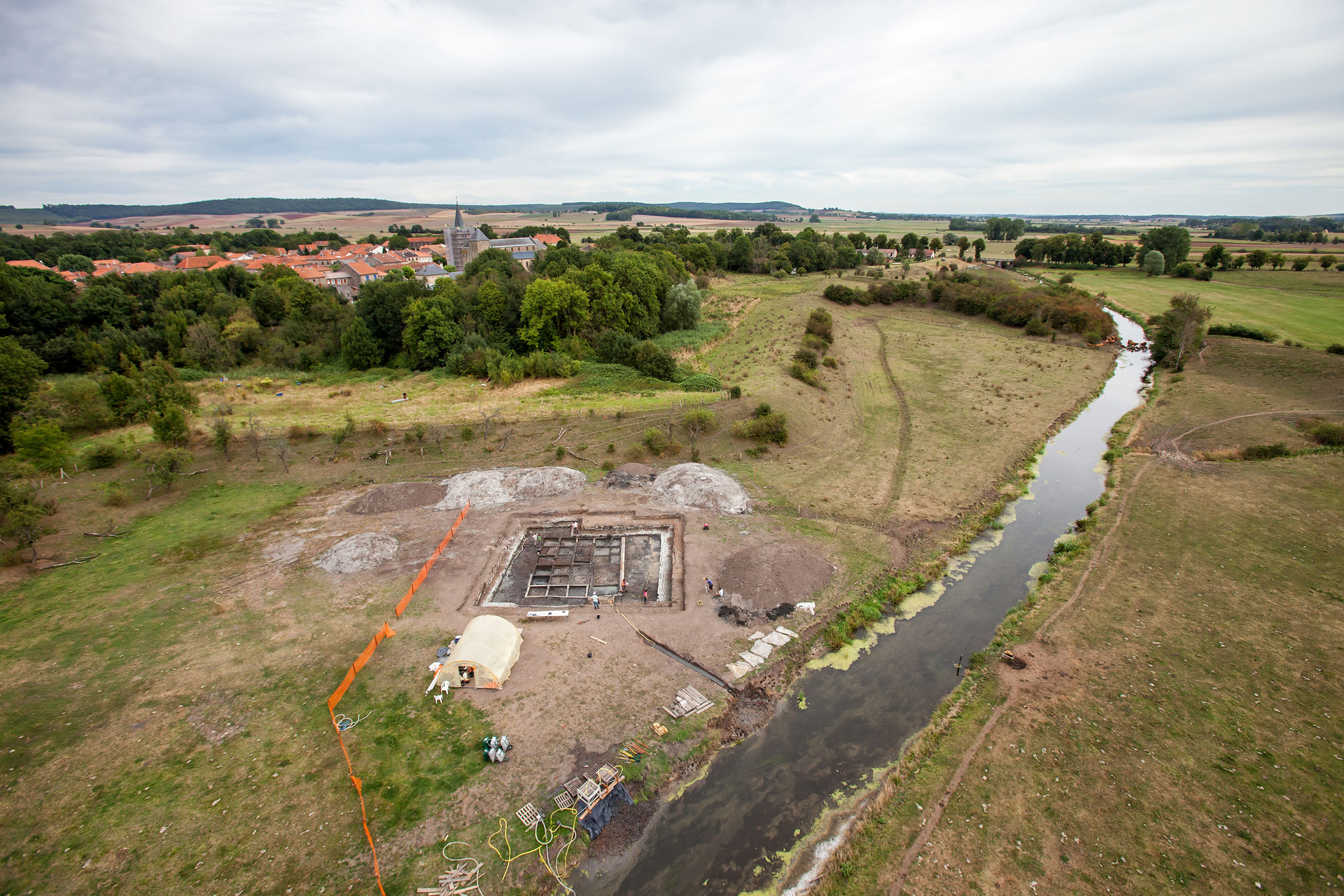
The Seille valley has preserved huge quantities of terracotta, the largest in Europe: known as the Briquetage de la Seille, they are the remains of the production activities of a series of pre-Roman saltworks spread over a distance of more than 10 km.
The white gold of the Celts
What is salt used for?
Prior to the invention of refrigeration techniques, salt was the main means of preserving food. Meat can be preserved by curing it with salt and vegetables can be preserved in brine. Other food products, such as cheeses, are made with salt. Salt is also used as a feed supplement to keep livestock healthy and productive. As soon as human communities settled in the Neolithic period, they needed a regular supply of salt.
Where does salt come from?
Salt can be extracted from seawater, but apart from in some exceptional cases, it is not found inland. This continental salt is a fossil salt, known as rock salt, which comes from ancient seas from geological times. It can be mined, as in the Alps, but it can also be dissolved by underground water flows and seep to the surface in the form of salt springs. These natural springs of salt water were intensively exploited during prehistory and the Metal Ages, as they provided exceptional salt resources several hundred kilometres from the shores of the sea.
Continental briquetage sites
A series of continental salt springs, located mainly between north-eastern France and eastern Germany, were exploited during Protohistory using a technique known as briquetage. These remains of terracotta salt moulds are associated with a technique used to produce salt by artificially heating brine in furnaces.
There are several sites of major importance in Germany, including Halle (Saxony-Anhalt), Bad Nauheim (Hesse) and Schwäbisch Hall (Baden-Württemberg). They mainly date from the Iron Age. However, the largest operations are located in Lorraine, around Marsal (Moselle). These Celtic and Gaulish saltworks needed to supply vast populations, stretching as far as Alsace, Saar-Palatinate, Champagne and Burgundy.
How did the Celts and Gauls obtain salt?
Between Salonnes and Marsal (Moselle), a series of salt springs were intensively exploited for more than 500 years during the Iron Age, using a technique known as briquetage. Between spring and summer, Celtic and Gallic salt workers drew brine by dissolving an underground rock salt formation some sixty metres below the surface.
The salt water was then enriched by adding cleaning agents from salty soils harvested nearby, before being concentrated in basins exposed to the wind and sun. The saturated brine was then poured into terracotta basins, which were heated in furnaces. It was then that the salt precipitated into crystals, which were harvested.
The Briquetage de la Seille
These salt crystals could then be packaged in the form of salt blocks. The salt paste that had just been extracted was poured into porous terracotta moulds, which were then heated in other furnaces. At the end of the operation, the moulds were broken open to release the salt blocks and the fragments of the moulds were left behind.
The intensive nature of production created huge quantities of waste from mould fragments and support grates for loading the furnaces. This debris gradually accumulated to form large waste heaps, some of which are still 12 m high, as seen in the town of Moyenvic. Their total mass is estimated at several million cubic metres.
This early salt industry was disrupted by the Roman conquest in the first decades of the 1st century AD. It was succeeded by Roman saltworks, in which the brine was heated in metal vats (usually made of lead) known as salt pans.
Early research, from Louis XIV to the German annexation of 1871
Discovered at the end of the 17th century during fortification works at Marsal commissioned by Vauban, the accumulated debris at Briquetage de la Seille was initially attributed to the Romans by the royal engineer Artézé de la Sauvagère. They retained their mystery throughout the 19th century, when they were considered remains potentially dating from the Palaeolithic to the early Middle Ages.
It was the first excavations in 1901, carried out by the new German curator of the Metz Museum, Johann Baptist Keune, that led to the discovery that these terracotta pieces were the remains of a salt extraction operation that used fire and dated from the Early Iron Age (8th–6th century BC).
It was from this point onwards that the term "briquetage" came to be used to describe similar remains of prehistoric salt production found in Europe, the New World and Asia.
Research in the 1970s
A series of test pits dug from 1969 onwards by archaeologist Jean-Paul Bertaux revealed the range of different terracotta vessels used to heat the brine and mould the salt blocks. These excavations also revealed the first brine furnaces, discovered at Marsal.
However, in the absence of large-scale surveys, the chronology of Briquetage de la Seille remains poorly known, as do the extent and organisation of the saltworkers' workshops.
A reconnaissance mission at landscape level
Since 2001, a multi-disciplinary research programme has been developed by the National Archaeology Museum to study this group of sites, which is exceptional internationally for its contribution to the archaeology of salt. The first step involved using airborne geophysical surveys to determine the location of the various production zones, which can cover several dozen hectares.
Other ground-based geophysical surveys carried out on these concentrations of workshops highlighted the organisation of the installations and the distribution of the furnaces, providing guidance for targeted test pits or excavations.
Industrial production from the Iron Age
A series of test pits has enabled us to establish the chronology of this industry and the salt production technique used at Briquetage de la Seille. In this way, we have been able to reconstruct the general development of the technology used by Celtic and Gallic salt workers, which was based on a truly industrial approach.
Finally, soil coring has been used to reconstruct the history of this part of the Seille valley over the last 10,000 years. This enabled us to assess the impact of this industrial activity on the natural environment and human occupation over the long term.
How did the Celtic and Gallic salt workers live?
Targeted excavations carried out at several workshops have made it possible to study the internal organisation of Celtic saltworks and to reconstruct the "production line" of salt extraction, from the drawing of the brine to the making of the salt blocks.
Surveys carried out on the outskirts of the workshop areas have uncovered the probable necropolises of the saltworkers, which were occupied throughout the Iron Age. Some of these graves belonged to the privileged classes of Celtic and Gaulish societies.
Long-term impact on the natural and human environment
Finally, surface surveys carried out throughout the valley have enabled us to reconstruct the changes in human occupation from prehistoric times to the modern period. They showed how accumulations of industrial waste from the Briquetage de la Seille changed the topography and environment, forcing later settlements to adapt to an environment that was gradually transformed into a vast marshland.
The archaeological collections
The collections from the 1901 excavations led by Johann Baptist Keune are held at the Metz Museum (Moselle).
Some of the items excavated by Jean-Paul Bertaux are held at Marsal Salt Museum (Moselle).
The collections produced by the National Archaeology Museum's research are destined for the National Archaeology Museum in Saint-Germain-en-Laye.

The project's scientific partners
Some twenty scientific partners, mainly European, have joined forces to support the Briquetage de la Seille research project:
In France:
- The Geological and Mining Research Bureau (Orléans)
- The Bliesbruck-Reinheim European Archaeological Centre (Moselle)
- The Centre for Research and Restoration in French Museums (Paris)
- The Geoarcheon Group (Vieville-sous-les-Côtes)
- The Archaeo-materials Research Institute (Orléans)
- The Institute of Planetary Physics (Paris)
- The Archaeogenic Molecular Anthropology Laboratory (Strasbourg)
- The Compiègne Archaeozoology Laboratory
- The ARC-Nucléart Laboratory (Grenoble)
- The Visual Forensic Laboratory (Strasbourg)
Internationally:
- The German Federal Geological Service BGR (Hanover, Germany)
- The Curt Engelhorn Centre (Mannheim, Germany)
- The ArchaeoScape Group (University of London, UK)
- The Osteoarchaeology Group (Mainz, Germany)
- The Posselt und Zickgraf Prospektionen Group (Marburg, Germany)
- The Beta Analytic Laboratory (Miami, USA)
- The Dendronet Laboratory (Bohlingen, Germany)
- The Max Planck Institute (Leipzig, Germany)
- The University of Louvain-la-Neuve (Belgium)
- Peking University (China)
- The University of Wisconsin (USA)
Listen
- Le sel : l’or blanc des Gaulois (Salt: the white gold of the Gauls) [in French]. France Culture's Le Salon Noir programme from 4 February 2014 [in French].
Watch
- Marsal, l'atelier de sauniers celtique (Marsal, the Celtic saltworkers' workshop), Dailymotion, Bruno Bronchain, 9 August 2011 [in French].
- Laurent Olivier presents the 2015 campaign in Marsal. Bruno Rondeau, YouTube, 3 August 2015 [in French].
- End-of-dig conference with Laurent Olivier. Bruno Rondeau, YouTube, 29 August 2017 [in French].
Useful links
- Briquetage de la Seille, Wikipedia entry