

Foz do Chapecó
In the upper Uruguay River valley, in southern Brazil, the Foz do Chapecó region provides a wealth of archaeological evidence covering the entire history of the local indigenous peoples prior to European colonisation.
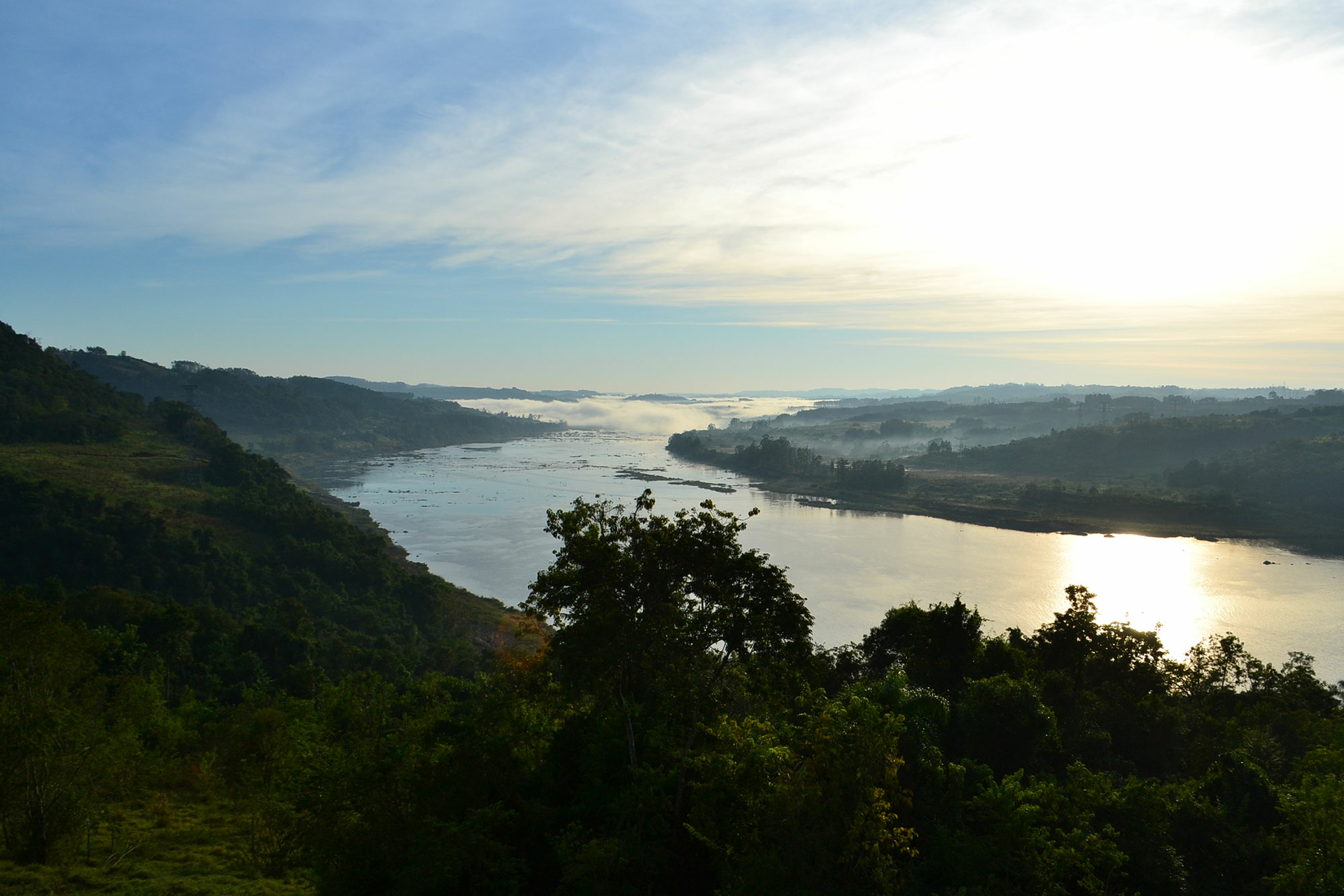
Discovered during preventive archaeological surveys in 2006, the Foz do Chapecó region has been the subject of an international research project since 2013. Excavations at the Linha Policial 7 and Uruguai 1 sites are providing previously unknown insights into the earliest populations of the southern plateau of Brazil.
Early settlements in southern Brazil
The stratigraphic sequences at Linha Policial 7 and Uruguai 1 reveal a succession of settlements on both banks of the River Uruguay between 12,000 and 9,500 years before present. This places these sites amongst the ten or so archaeological sites dating from the early Holocene in southern Brazil (an area equivalent in size to mainland France). The lower layer of Linha Policial 7 is in fact the oldest evidence of human presence known to date in the state of Santa Catarina. These archaeological layers mainly contain tools and waste from cut stone produced from local rock types: pebbles and blocks of sandstone, flint, chalcedony, quartz and basalt. A small number of bone remains and hearths suggest that hunting and fishing took place in the surrounding area and that the resources obtained were consumed on site. The composition of the assemblages reflects temporary and repeated stops.
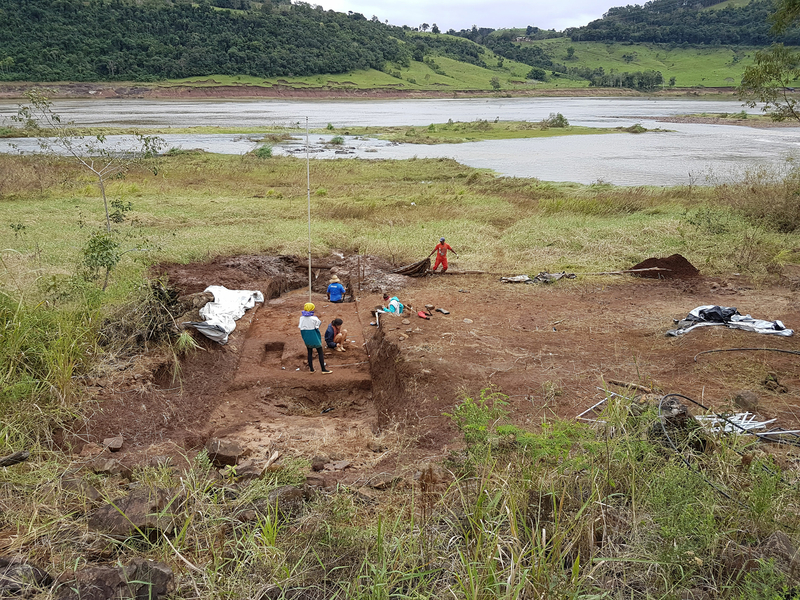
Secteur 1 du site Linha Policial 7 en cours de fouille © PAFSUB
A thriving stone tool industry
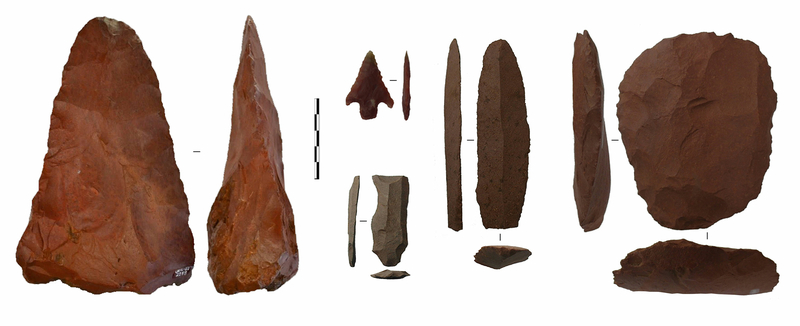
The wealth of the stone tool industry at Foz do Chapecó is impressive. Not because of the quantity — since the few thousand artefacts found do not indicate any particular abundance — but because of their diversity and technical quality. A sample of most of the major families of stone tool-making techniques known from prehistory was in use at Linha Policial 7 and Uruguai 1 during the early Holocene: bifacial working, flake production using both predetermined and non-predetermined methods — some of which involved bipolar knapping — and, between 10,500 and 9,500 years before present, laminate flake production. This particular variety is not found anywhere else in Brazil. The tools recovered are varied: massive bifaces, all types of flake tools, retouched blades (primarily along the long edges), bifacial projectile points, etc. This diversity contrasts with the common perception of the technology of the earliest populations of southern Brazil, for whom only a standardised production of projectile points is often documented, whilst the manufacture of everyday tools is described as makeshift or rudimentary. The sites in the Foz do Chapecó region help to shed light on the earliest stages of settlement in southern Brazil, highlighting a local characteristic that is undoubtedly linked to the specific dynamics of the Río de la Plata basin and the neighbouring regions of Argentina and Uruguay.
A dense Tupiguarani settlement
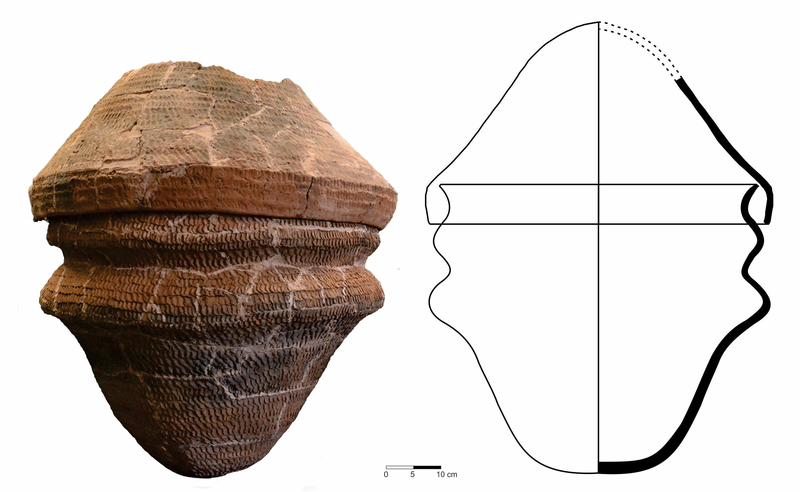
Foz do Chapecó continued to be inhabited throughout the Middle Holocene, but the archaeological layers from this period, which are less prominent, have yet to be explored in detail. However, towards the end of this period, around 500 years ago, a large population established a village at Uruguai 1. It is associated, particularly in terms of its pottery, with the archaeological tradition known as ‘Tupiguarani’, which is extremely widespread throughout southern Brazil. These upper archaeological layers have yielded domestic structures, hearths, waste disposal areas, stone tools, pottery fragments, ornaments and burial structures (either inside large pottery urns or directly in the ground). It offers an opportunity to gain an insight into the daily lives of indigenous peoples on the eve of European colonisation.
Useful links
- Website of the Franco-Brazilian programme, featuring photos, partner organisations and institutions, and a list of publications: pafsub.wixsite.com