

Cylinder seals from the Middle East
Engraved in intaglio on small stone cylinders designed to be rolled over fresh clay, the cylinder seals of the Ancient Middle East depict a wide variety of figures from the real and imaginary worlds. They sometimes bear an inscription. Their history is closely linked to that of cuneiform writing.
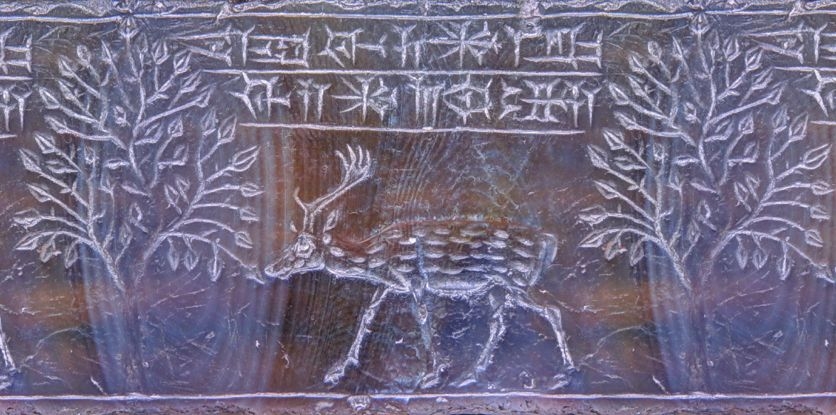
Small stone cylinders
Oriental cylinder seals are, as their name suggests, small cylindrical objects (roughly the size of a bottle stopper) which form a distinctive body of artefacts characteristic of the civilisations of the ancient Middle East. Usually made of hard stone, they are engraved in intaglio with a scene — figurative or otherwise — sometimes accompanied by an inscription. This engraving was carved out of the cylinder, so that a positive impression would appear on the fresh clay of the tablets or seals onto which the seal was rolled.
The invention of the signature
In Mesopotamia, the history of cylinder seals is closely linked to that of cuneiform writing on clay tablets. These objects were used, in particular, to seal and authenticate administrative documents or official papers. The seal impression, whether or not it bore an inscription, therefore served as a signature, attesting to the ownership of an individual or an institution, their commitment to a transaction, or the legality of the transaction. Seals, which were also regarded as prestigious items, were often made from rare, colourful and exotic materials.
A wealth of iconography
From the very beginning, at the end of the 4th millennium BC, and for more than three thousand years, these cylinder seals developed a specific narrative structure and function, to the extent that the iconography of what is known as glyptics has become a field of study in its own right within Middle Eastern archaeology. During certain periods (such as that of the Akkadian Empire, for example, around 2300 BC), the range of subjects depicted in the scenes on these seals was remarkably rich.
The cylinder seals of the Bibliothèque nationale de France (BnF)
It is estimated that there are more than 50,000 cylinder seals and Oriental seals currently held in collections around the world, and perhaps as many as 200,000 or 300,000 tablets and objects bearing a seal impression. Today, the latest digital imaging techniques make it possible to explore new ways of presenting these miniature engravings, to highlight the splendour and variety of the materials used, and to study the engraving techniques in greater detail. In this context, the collection of oriental cylinder seals and stamps held by the Bibliothèque nationale de France is of particular interest, given the unique history of its formation over more than two centuries.
The SESPOA programme
The research programme ‘Seals and Seal Imprints of the Ancient Middle East’ (SESPOA http://sespoa.huma-num.fr) is a joint initiative between the CNRS ‘Orient Cunéiforme’ team at the MSH Mondes in Nanterre (UMR 7041) and a team from the Faculty of Oriental Studies at the University of Oxford. Hosted by the BnF's Department of Coins, Medals and Antiquities, this programme is supported by the LabEx ‘Les passés dans le présent’ (http://passes-present.eu/fr).