Mari: looting and destruction
Although recent conflicts have damaged the site of Mari, it was also looted in much earlier times. Archaeologists have identified evidence of ancient looting which disturbed the site’s stratigraphy on several occasions. During the Second World War, the site and excavation house in which the equipment was stored were hit by a further wave of destruction. History has repeated itself at Mari, but the damage is being analysed before any further archaeological activities are undertaken.
Mathilde Mura. Digital Globe Foundation with kind permission of Frank Braemer
Mathilde Mura. Digital Globe Foundation with kind permission of Frank Braemer
Vist the site : Mari
One year on, only a few new ground depressions caused by looting are visible on the images. The areas selected may be less rich in archaeological remains (south of the tell) or illegal digging may have been limited by some form of administrative control. The site of Tell Madkouk, on the other hand, has been completely razed to the ground and satellite images show the use of a mechanical digger to destroy the mound northwest of Mari.
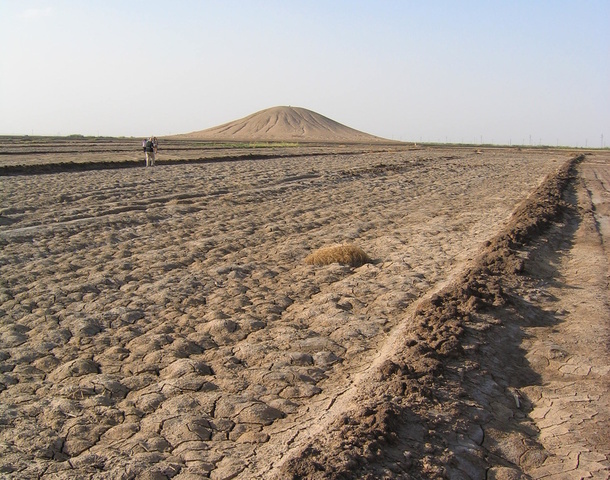
Mission archéologique de Mari. Photo P. Butterlin
Between March and November 2014, a major expansion in looting was noted towards the central unexcavated areas. However, circular, irregular-shaped impressions with eroded edges (less than 3 metres in diameter) suggest the looting was done by hand. The dense network and intensive nature of the digging to the east of the Maison Rouge indicate that illegal excavations in this area were probably productive.
The first traces of looting observed on the Mari site suggest it was concentrated in the northeast area and around the royal palace. This corresponds to the area already excavated and known to contain cuneiform tablets. The depressions, up to 9 metres long, with sharp edges and regular imprints, suggest illegal mechanised excavations. The use of mechanical diggers may mean the looting, which was done openly, was carefully managed.