

The ‘fossil beach’ at Mormolo
The Mormolo site extends across a raised beach at an altitude of approximately 100 m above sea level and is covered by a thick deposit of red sand dating from the Middle Pleistocene (781–126 ka), which contains several archaeological layers from the Palaeolithic period.

The Franco-Angolan Prehistoric Mission is working to gain a better understanding of the ways of life and the use of semi-arid coastal areas by ancient hominins in Benguela Province more than 600,000 years ago, through the excavation of stone-knapping workshops and fossil-bearing sites.
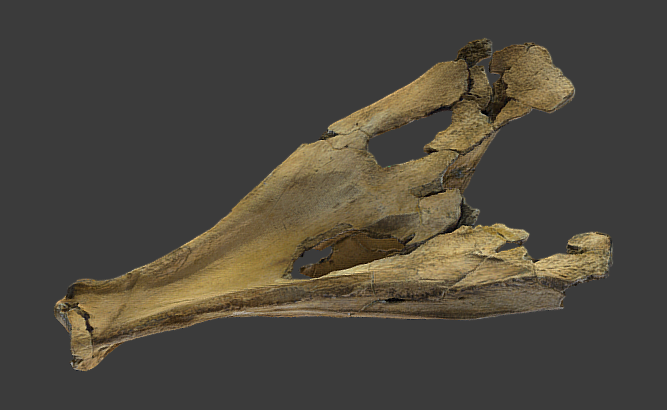
The multidisciplinary team, comprising, amongst others, Maria-Helena Benjamim, Katyana Raul, Raphaël Hanon, Eslem Ben Arous, Diego Dias Pavei, Thibaud Saos and Anne-Elisabeth Lebatard, has enabled work to begin on constructing a chronostratigraphic sequence to provide a robust chronology spanning approximately 1 million to 200,000 years ago, but also to provide the first elements for reconstructing palaeoenvironments through the discovery and study of fossil remains of malacofauna and the remains of a species of proboscidian that has been extinct for several hundred thousand years. Work is currently underway on isotopic studies and the combination of different dating methods.
These chronological and palaeo-environmental data, which are entirely new for the region, are combined with a more culturalist approach to the study of worked stone and prehistoric craftsmanship. The earliest prehistoric communities to settle along this stretch of coastline did indeed make use of the coastal lithological resources and developed a distinctive set of tools based on the flaking of quartz beach pebbles. These groups are contemporary with the settlements of Homo erectus on the African continent and with the Acheulean techno-complex. Nevertheless, no palaeoanthropological remains have yet been discovered in the region, and the artefacts point to an atypical technology, a form of ‘local technical trajectory’.


Every year, excavations take place in Benguela Province in collaboration with the Museu Nacional de Arqueologia de Benguela, involving students from a variety of backgrounds. Within the next few years, we hope to gain a better understanding of the chronological and environmental context in which these ancient populations settled and adapted, as well as how these groups moved along the coastline to exploit its resources.
Explore the Ndalambiri rock shelter and some iconic archaeological remains in 3D:



Learn more
https://journals.plos.org/plosone/article?id=10.1371/journal.pone.0278775
Angolan Archaeology 1 – The National Archaeology Museum in Benguela, Angola:
Angolan Archaeology 2 – The Mormolo Archaeological Project: